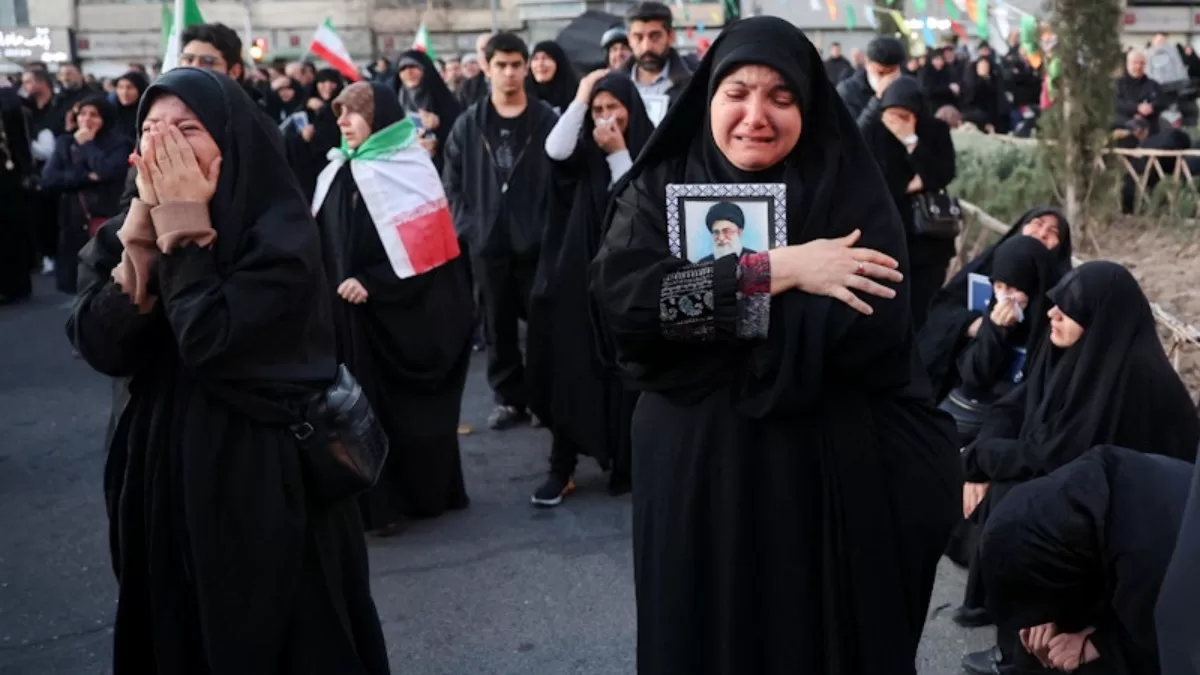
Ayatollah Ali Khamenei, the Supreme Leader of Iran, was killed on February 28 in Tehran as a result of a joint air operation by the United States and Israel. Iran’s state television IRIB confirmed his death, calling it “martyrdom,” after the Israel Defense Forces and U.S. President Donald Trump had earlier reported his elimination. Khamenei had led the country since 1989 and was considered the key figure of the Islamic Republic.
Along with him, the commander of the Islamic Revolutionary Guard Corps Mohammad Pakpour and Iran’s Defense Council secretary Ali Shamkhani were also killed in the strikes. After their deaths were confirmed, the authorities declared 40 days of mourning in the country and made the first week non-working, Western media report.
Temporary leadership of the state has been transferred to a special council that includes Iranian President Masoud Pezeshkian, the head of the judiciary, and a representative of the Guardian Council. The appointment of a new Supreme Leader must be handled by the Assembly of Experts, a body of 88 clerics authorized to choose the country’s spiritual leader.
Reza Pahlavi, the son of the last Shah of Iran who has lived in exile since the 1979 revolution, welcomed Khamenei’s death and said that with his killing the Islamic Republic had effectively ceased to exist. He called on security forces not to appoint a successor and to side with the people, describing the events as “the beginning of national liberation.”
U.S. President Donald Trump said that the strikes on Iran had caused significant damage to the country’s leadership and eliminated many senior officials. According to him, the operation was authorized after negotiations on Iran’s nuclear program in Geneva reached a dead end. Trump also said the United States has a good idea of who could lead Iran next and allowed for both the continuation of the operation and its quick end if Tehran abandons its nuclear program.
In the first wave of the U.S.–Israeli operation, dozens of military targets were hit, including missile launchers and infrastructure of the Islamic Revolutionary Guard Corps. According to preliminary information, Iran responded with missile strikes on U.S. bases in Qatar, Kuwait, Bahrain, the UAE, and Jordan. Activation of pro-Iranian militias in Iraq is also expected, possible intervention by the Yemeni Houthis is being discussed, while Hezbollah has not yet entered the fighting, although Israel is preparing for such a scenario.
The Israeli army says events are developing according to plan, and intensive fighting is possible in the coming days in order to максимально weaken Iran’s military capabilities, including its missile and nuclear programs, the IRGC forces, and internal repression structures.
World leaders reacted differently to the events. The United Kingdom government said it did not take part in the operation and opposes escalation, but stressed the need to prevent Iran from developing nuclear weapons. In Germany, officials said Berlin had been informed in advance about the strikes, and Chancellor Friedrich Merz is in contact with partners and plans talks with Donald Trump.
French President Emmanuel Macron called for an emergency meeting of the UN Security Council and demanded that Tehran return to negotiations on its nuclear program. EU foreign policy chief Kaja Kallas said the European Union, together with partners, is seeking a diplomatic solution. Italy expressed solidarity with the civilian population of Iran, while Switzerland called on the parties to respect international law and show restraint.
Australia supported U.S. efforts to prevent Iran from obtaining nuclear weapons while also expressing solidarity with the Iranian people. Russia strongly condemned the strikes, calling them an act of aggression and a violation of international law.
President of Ukraine Volodymyr Zelenskyy supported the U.S. actions but stressed the need to avoid further escalation. He said the Iranian regime had helped Russia in the war against Ukraine by supplying Shahed drones and related technologies, noting that since the start of the invasion Russian forces have used more than 57,000 such drones. According to him, the events may give the Iranian people a chance to get rid of a regime that cooperates with Moscow.