
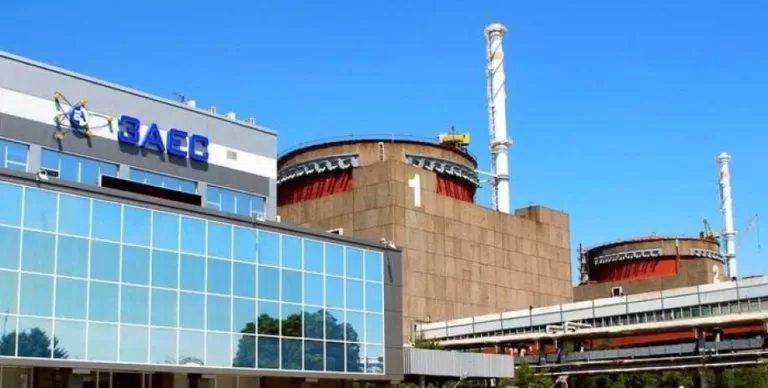
IAEA Director General Rafael Mariano Grossi announced that after several weeks of intensive contacts with Ukraine and Russia, a process has begun to restore external power to the Zaporizhzhia Nuclear Power Plant (ZNPP).
According to Grossi, the goal is to create safe conditions for repairing the damaged sections of the 750 kV Dniprovska and 330 kV Ferosplavna-1 power lines, located on opposite sides of the front line near the plant. These lines are essential for reconnecting ZNPP to the national grid.
“Following intensive consultations, the process leading to the re-establishment of off-site power through the Dniprovska and Ferosplavna-1 lines has started. Although this will take some time, both sides are engaging with us constructively to achieve this vital objective for the sake of nuclear safety. No one stands to gain from a further deterioration of the situation,” Grossi said.
Since September 23, when ZNPP lost its last remaining connection to the grid, the plant has been forced to rely on emergency diesel generators (EDGs) to power cooling systems for its six shut-down reactors and spent fuel pools. Currently, seven generators are operating and another thirteen are on standby.
The IAEA reports that radiation levels at the site remain within normal limits, and the temperature of the coolant in the reactors and pools has not increased — confirming that the fuel continues to be cooled effectively.
The Agency’s mission also recorded explosions near the plant: on Tuesday evening, the team heard five detonations in succession that shook the windows of the building they were in.
The IAEA notes that military activity is also being observed near other Ukrainian nuclear sites — Khmelnitskyy, Rivne, South Ukraine, and Chornobyl. In particular, on October 4, sixteen drones were detected near the Khmelnitskyy NPP, the closest just 5.5 km from the site, and the next day three drones were recorded north of the South Ukraine plant.
At the Chornobyl site, there is still no access to the 330 kV power line damaged during strikes near the town of Slavutych.
This week, under the IAEA’s nuclear safety assistance program, the Khmelnitskyy NPP received new radiation survey meters, funded by the Czech Republic and Japan. The total value of safety equipment delivered to Ukraine since the start of the war has now exceeded 20 million euros.