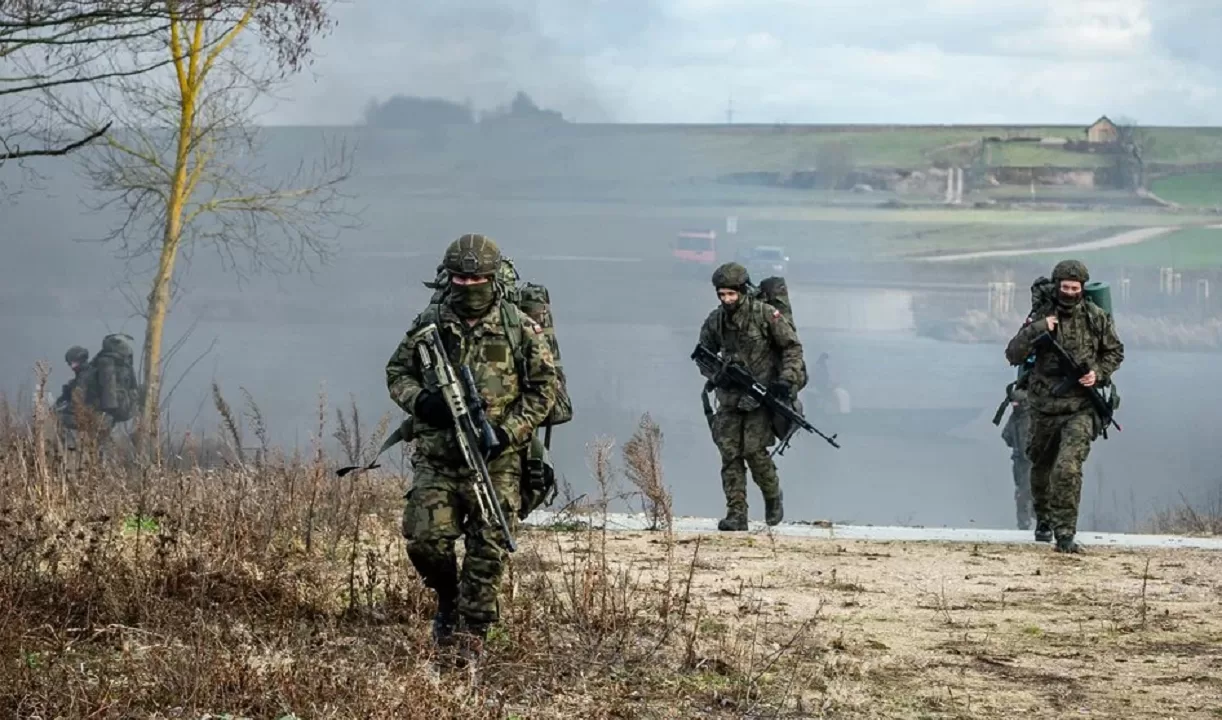
Poland’s Ministry of National Defence is working on a new law on the country’s defence readiness that is intended to fill the gap between the normal functioning of the state in peacetime and the formal introduction of martial law. The new rules should allow troops, including allied forces, to be redeployed more quickly, infrastructure to be prepared, and the powers of state authorities to be defined more clearly in the event of a growing military threat.
This was reported by Rzeczpospolita. The draft has already been prepared by the Polish Ministry of Defence and is currently undergoing internal consultations. Until recently, its working title explicitly included wording referring to the “state’s readiness for war.”
At the same time, this does not involve introducing a new formal “pre-war state.” This is how Polish sources quoted by the newspaper describe a period when the threat already requires enhanced defence measures, but there are still no grounds for declaring martial law.
Why Poland needs the new law
The Polish Ministry of Defence says the document is intended to strengthen the country’s defence capabilities, improve cooperation between the military and internal security services, and adapt legislation to modern threats.
Particular attention is expected to be paid to hybrid operations, cyberattacks and disinformation. A significant part of the rules governing the state’s defence preparations is currently contained in various government regulations, which, according to the ministry, makes it more difficult to apply them consistently.
The ministry believes that some of these provisions should be transferred directly into law because they define the tasks, powers and responsibilities of public administration bodies and other structures involved in the state’s defence system.
Troops could be redeployed before martial law is introduced
One of the key changes is the possibility of beginning the movement of military units to areas where a threat is emerging at an earlier stage.
This would apply not only to the Polish military but also to allied forces. At the same time, the necessary infrastructure would be prepared for their reception and deployment.
Poland’s Defence Response Plan is also expected to be linked more closely with the NATO Response System.
In other words, some procedures that under the current model could be launched only at a later stage of a crisis are intended to become available earlier.
More civilian structures will be involved in the defence system
The changes will not affect the military alone.
The new law is expected to increase the number of institutions and organisations involved in the permanent duty system and in state defence management.
Separate rules are also planned for civilian employees working at command posts in situations where their ability to leave their workplaces and return home may be restricted.
Changes are also envisaged in non-military operational planning, defence programming, training, specialised courses and exercises.
The non-military part of the preparations — central authorities, public administration and local governments — is one of the main areas covered by the current draft.
Poland has already changed its defence readiness system
The groundwork for the current reform was laid in March 2025, when the Polish government changed the rules governing the country’s defence readiness.
Instead of the previous three states, two were retained: permanent defence readiness and full defence readiness.
Permanent readiness applies in peacetime. It includes defence planning, training, maintaining alert and permanent duty systems, as well as preparing for hybrid threats such as cyberattacks and disinformation.
Full defence readiness can be introduced in the event of an external threat to Poland’s security or during wartime. It allows mobilisation and the full deployment of the country’s defence system.
The decision to change the level of readiness is made by the President of Poland upon a request from the Council of Ministers.
“A gap between peace and martial law”
A Rzeczpospolita source linked to the presidential office described the new initiative as preparing the state for a “pre-war period,” something Prime Minister Donald Tusk had previously spoken about.
The idea is that the state should not wait until the threat becomes so serious that martial law has to be formally introduced.
Administrative, logistical and defence mechanisms should be activated earlier — when signs of danger are already clear but the country formally remains in peacetime.
Experts highlight hybrid threats
Grzegorz Matyasik, a former deputy director of Poland’s Government Centre for Security, believes the state primarily needs to adapt its legislation to new types of threats.
In his view, the previous rules did not sufficiently take into account hybrid operations and the protection of critical infrastructure.
He also supports a broader approach in which legislation would cover not only traditional military defence but also crisis management and the overall resilience of state institutions.
Michał Dworczyk, vice-chair of the European Parliament’s Committee on Security and Defence, said that streamlining fragmented and sometimes unclear regulations is necessary, although the specific bill can only be assessed after its text is made public.
He stressed that the state should be prepared for different scenarios amid Russia’s actions toward NATO countries, but that the new rules should respond to real challenges and undergo proper consultation.
Poland has tried to adopt a similar bill before
The idea of regulating state action during the period between peace and open war is not new in Poland.
Back in 2023, during Andrzej Duda’s presidency, then-head of the National Security Bureau Jacek Siewiera prepared a bill on the actions of state authorities in the event of an external threat to national security.
It also proposed moving some rules on defence readiness from government regulations into law and allowing selective increases in combat readiness. The draft also envisaged changes to the command system of the Armed Forces.
At the time, it was proposed, among other things, to allow military units to be designated and moved to areas of threat in the event of a concentration of foreign troops or unidentified armed formations near the border.
However, that bill never entered into force, and Donald Tusk’s government later incorporated some of the proposed mechanisms into government regulations.
Defence Ministry: this is a different project
The Polish Ministry of Defence stresses that the current initiative is not simply a return to the project prepared during Duda’s presidency.
The previous document covered operational planning in the Armed Forces, defence response and the military command system.
The current bill focuses primarily on non-military defence preparations — from central government to local authorities — and their ability to carry out tasks in support of the Armed Forces.
It is not yet known when the document will be submitted to the Sejm. The Ministry of Defence says the draft is going through a complex consultation process, so there is currently no specific date for its submission to parliament.