
“I’m not worried about myself — I’m worried about my husband. Right now he’s leaving his position,” says Sasha.
She is 22 and is going on a date with her loved one in Kramatorsk.
“The road there is long, but full of hope. It’s much harder to come back,” the girl continues.
In the platzkart carriage heading from Lviv to Barvinkove, on the border of the Kharkiv region, the passengers are mostly soldiers and women of different ages. The younger ones, like Sasha, are traveling for an eagerly awaited but short-lived reunion with their husbands. The older ones are going to pick up relatives, check on their homes, or patch up windows in apartments that have been hit by a Russian drone or guided bomb, according to a report by BBC Ukraine.
On November 5, Ukrzaliznytsia suspended train traffic in the Donetsk region. Since then, the terminal for the Kramatorsk direction has been a small town on the border of the Kharkiv and Donetsk regions. From there, only buses go further. According to locals, the trip takes about two hours.
The train to Kramatorsk has long been nicknamed the “train of love”. Couples who were forced apart by the war used to reunite on the city platform.
It still carries love to frontline cities. Only recently has the journey required a transfer to a bus, due to intensified attacks on railway infrastructure and the advancing frontline.
“At the moment of that transfer anything can happen. And even while you’re on the train, anything can happen,” Sasha shares. “But it’s good that the trains are still running, because that gives us hope.”


A date in Kramatorsk
Sasha got married in August this year.
“Dmytro told me right away, ‘You will be my wife.’ I didn’t believe him. I didn’t even plan to get married before 25,” she says with a smile.
She travels to Kramatorsk regularly, almost every month — and would like to do it more often. But getting time off in the army is difficult.
Trips to Donetsk region from Kyiv have become the most anticipated event of the month for Sasha.
After getting married, she even considered moving to Kramatorsk. The thought still hasn’t left her.
“We talked about it in early September, then a month ago, and again a week ago. We talk about it all the time. But obviously, right now it’s impossible, because Kramatorsk is dangerous,” she explains.
Dmytro chooses relatively quiet and safer areas of the city for their few days together, but even there it is “very loud” and there are “a lot of strikes”.
“When he is sleeping next to me, I’m not afraid of anything,” Sasha says confidently.
Sasha’s husband is a professional soldier. Seven of his 26 years he has devoted to service in the Armed Forces of Ukraine.
“All the men in my family serve. My dad is a police officer, but even after retirement he joined the Armed Forces. My older brother is also in the military,” she explains.
She had booked herself a bed in an SV carriage in advance. But at the last moment her husband was not released from rotation, and she had to look for a ticket on other dates. That’s how she ended up in the platzkart coach.
Another route — through Dnipro — also has its downsides.
“Once, during a transfer near Dnipro, there was a Russian strike on a gas station very close by. It’s an understatement to say that everyone was scared,” she recalls.
According to Sasha, even a short meeting with her loved one makes all the hardships of the journey worthwhile.
The train she is on from Kyiv is high-speed. But on that day it was running at least two hours late.
“Up to Poltava it really moves fast,” the train chief explains. “But in the Kharkiv region, because of shelling of the infrastructure, we have to take detours. It’s never entirely clear when we’ll arrive. People figure it out on the spot.”
Getting from the train’s final stop to Kramatorsk turned out to be an entire quest, Sasha admitted after returning to Kyiv. She didn’t immediately find the bus, which was parked on the other side of the town. In the end, it left without her.
“Surprisingly, I spotted a female taxi driver and simply begged her to take me to Kramatorsk,” she recalls. “We drove through the fog for almost three hours. Potholes everywhere. You can’t go faster than 20 kilometers per hour.”
During our entire conversation, Sasha keeps smiling. Her eyes shine with anticipation, her mood is elevated. At one point she picks up her red thermos cup and goes to get hot water for a ‘three-in-one’ cappuccino.
The next day she will walk in Yuvileinyi Park, drink coffee in Kramatorsk cafés, and pass by the local market.
And in the evening, that same market will be hit by a Russian Smerch multiple-launch rocket system, injuring two people.
“The only thing that keeps you going is common sense — the fact that we’re still alive, that there’s still communication, transport, and a chance to see each other,” Sasha says with a smile.
After each such meeting, she starts preparing for the next one.
The first visit to see her loved one
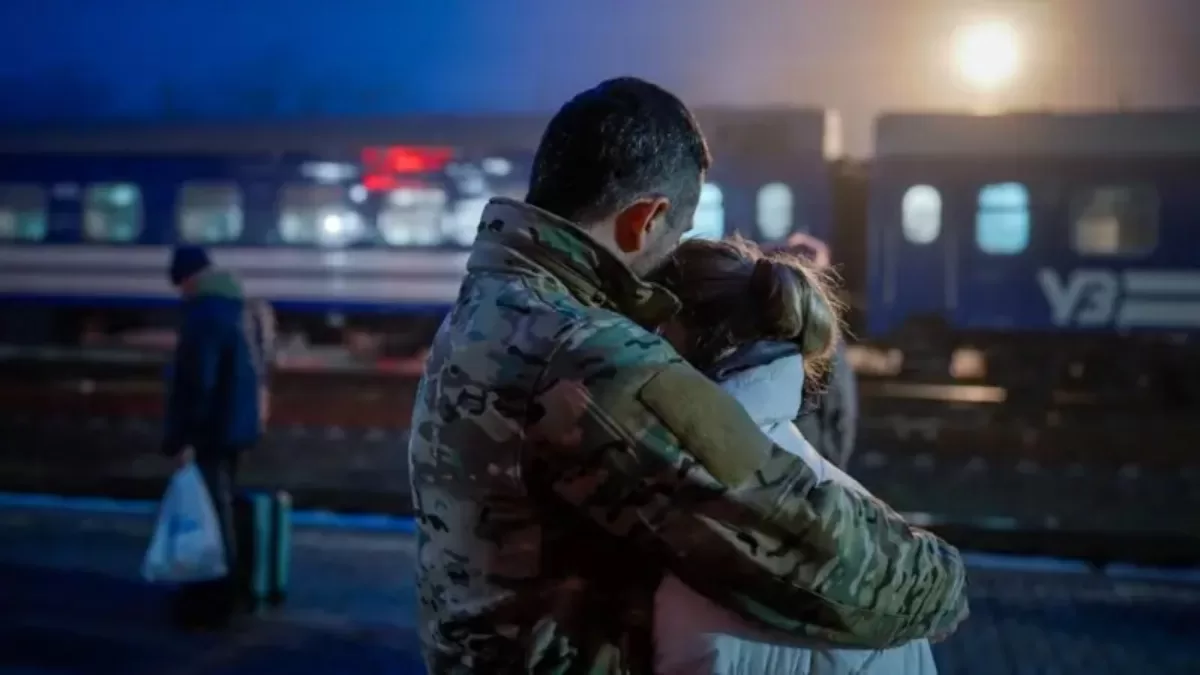
A bearded man in camouflage gently hugs a girl in a white jacket at the new terminal of the “train of love” in Barvinkove. The evening fog makes the scene more atmospheric, and for some — more calming.
When there’s fog, fewer drones fly, elderly women say as they step off the train.
In the darkness, people getting off the train can hardly tell where to go. The only thing left to do is follow the crowd, mostly men in camouflage.
“I took valerian so that I wouldn’t cry. Last time I cried the whole time, and we couldn’t even say goodbye properly,” says Polina, the same girl in the white jacket.
She met Andrii on a bus from Odesa to Kyiv four months ago. He was on his way to his unit. She was heading home from the sea.
“We watched the film The Blue Lagoon on the bus. It’s a masterpiece of cinema. Andrii had never seen it. In return, he recommended I watch The Beach with DiCaprio,” she recalls.
Polina is 24. And this is her first visit to Kramatorsk. Before that, Andrii came to Kyiv for short weekends.
“We haven’t been together for long, and we so desperately need this time together… At some point I told Andrii that I didn’t care anymore — I would come even for half a day just to have a coffee together,” she says.
Eventually, the soldier received leave, and Polina bought a train ticket.
Because of power outages, trains are often delayed — sometimes pulled by a diesel locomotive.
“When I arrived at the station in Kyiv, I found out that my train had been cancelled. So instead of an Intercity, I traveled in a compartment car. Meanwhile, Andrii was running around Sloviansk trying to find me some soup,” she says anxiously. “And when we were already approaching, an elderly woman came up to me and asked me to give her a ride. That’s how we met — he with the soup, and me with the grandma.”
Behind Polina on the bench is a bouquet of red roses. Later, the train attendant will take them and place them in a large bucket.
“That’s my version of an EW system,” she jokes, showing a photo of the flowers on the roof of a military pickup truck — the kind soldiers often call “a clunker”.
Before this trip to Kramatorsk, Polina had not seen Andrii for a month and a half.
“Long-distance relationships are hard,” she admits. “When Andrii doesn’t reply, I immediately start worrying… but at that time he could just be in the shower or something. On top of that, each time you kind of have to get used to each other’s physical presence all over again, because you haven’t known each other that long.”
At five in the morning, when Polina’s train arrived in Kyiv, the first thing she heard on the platform were explosions. That night the capital experienced one of its longest air raid alerts — more than 10 hours. Later it became known that dozens of people were injured and two were killed.
“It was calmer in Donetsk region,” Polina comments on her return home.
For Polina and Andrii, as for many other couples, that calm is rather an inner one — because it means a long-awaited meeting with their loved ones.
Meanwhile, the trains that bring wives to the frontline cities take whole families out from there. About two hundred people arrive daily at the evacuation hub on the border of the Kharkiv and Donetsk regions.
Some leave in their own vehicles with a clear plan for the future. Others wait for an evacuation train, which, although often delayed, will eventually arrive.