
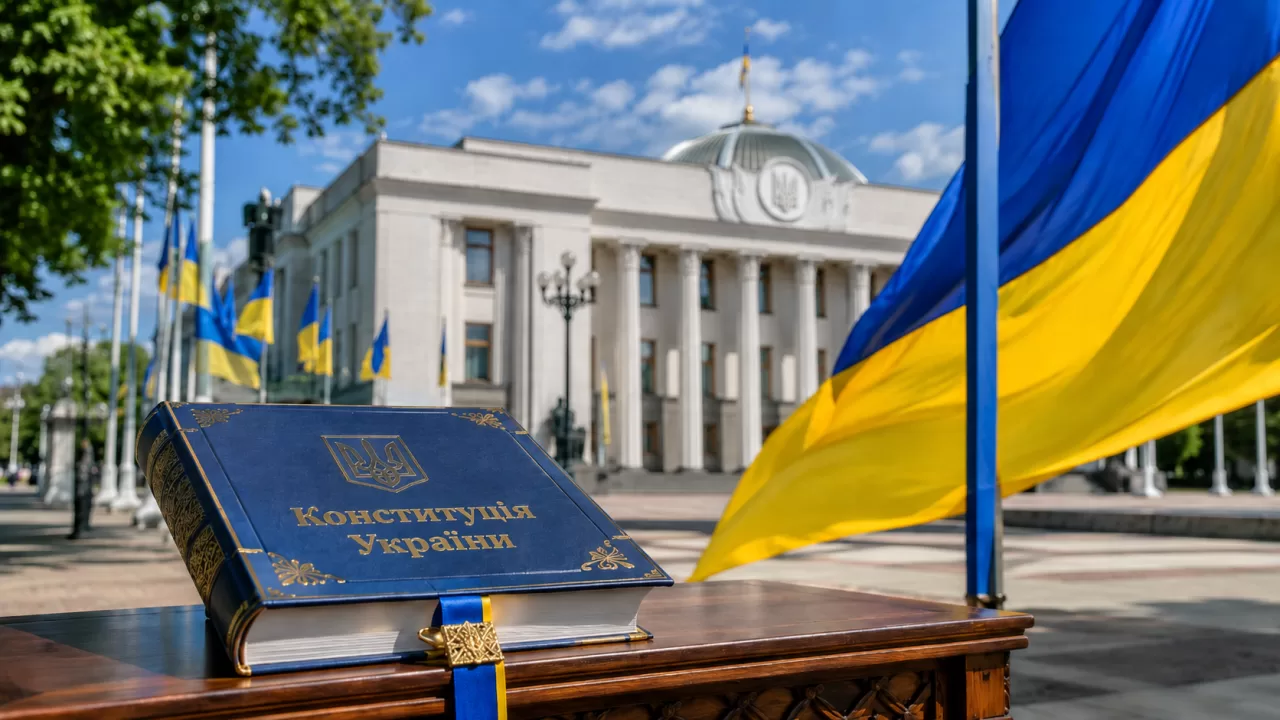
Today, June 28, Ukraine marks Constitution Day. The Verkhovna Rada adopted the country’s Basic Law 30 years ago, on June 28, 1996, after nearly 24 hours of continuous debate that went down in history as the “constitutional night.”
The Constitution became the first Basic Law of independent Ukraine. It replaced the Soviet-era Constitution of the Ukrainian SSR of 1978 and enshrined the key foundations of Ukrainian statehood: sovereignty, territorial integrity, human rights and freedoms, separation of powers, and local self-government.
Work on the Constitution lasted several years. In the 1990s, the document was the subject of fierce political disputes over the powers of the president and parliament, the status of Crimea, the state language, national symbols, private property rights, and the structure of the state.
The final vote took place on the morning of June 28, 1996. A total of 315 lawmakers voted in favor of adopting the Constitution — more than the required 300 votes.
One notable fact is that Ukraine was the last former Soviet republic to adopt a new Constitution after the collapse of the USSR. But this delay also allowed the document to include not only the formal attributes of independence, but also the mechanisms of a democratic state.
Another key point is that the Constitution defines Ukraine as a unitary state and declares its territory within the existing borders to be integral and inviolable. After Russia’s occupation of Crimea and the start of the war in Donbas, these provisions became not merely legal norms, but the foundation of Ukraine’s state position in its war with Russia.
During the full-scale invasion, the Constitution remains the framework for key state decisions. It defines the duty to defend the homeland, guarantees citizens’ rights, sets the principles for the functioning of state institutions, and at the same time limits any decisions that could call Ukraine’s sovereignty or territorial integrity into question.
That is why issues of peace, negotiations, mobilization, the status of occupied territories, language policy, citizens’ rights and Ukraine’s European course all ultimately relate to the Basic Law.
The Constitution is not a frozen document. Over the past 30 years, amendments have been made to it, including changes concerning the balance of powers between the president, parliament and government, the judicial system, and Ukraine’s strategic course toward membership in the European Union and NATO.
Constitution Day is the only public holiday directly enshrined in Ukraine’s Basic Law. In wartime, this date carries special significance: the Constitution is a reminder that Ukraine is fighting not only for its territory, but also for the right to remain an independent democratic state.