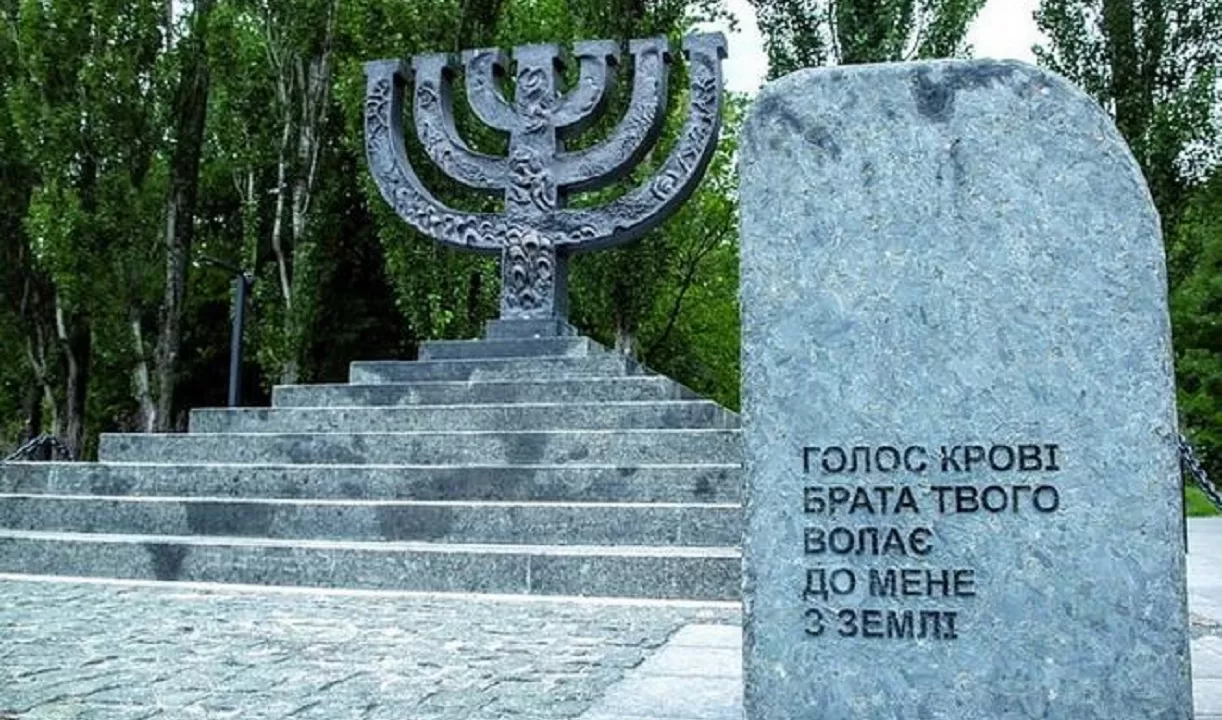
On September 29–30, Ukraine commemorates the victims of the Babyn Yar tragedy — one of the best-known sites of mass executions during the Nazi occupation. In just two days in September 1941, 33,771 Jews were killed there, while in total around 100,000 civilians and prisoners of war were murdered in Babyn Yar between 1941 and 1943.
This is stated in the information materials of the Ukrainian Institute of National Memory. Babyn Yar became a symbol of the so-called “Holocaust by bullets” — the mass murder of Jews by shooting in occupied territories.
A place where around 100,000 people were killed
Babyn Yar in Kyiv became a necropolis for tens of thousands of people of different backgrounds and status.
Among those killed were Jews and Roma, Soviet prisoners of war, communists, members of the Organization of Ukrainian Nationalists, prisoners of the Syrets concentration camp, underground resistance members, hostages, people accused of “sabotage” or violating curfew, as well as patients of the Pavlov Psychiatric Hospital.
The executions began almost immediately after German troops seized Kyiv in September 1941 and continued until the end of the occupation of the city. The largest punitive operation took place on September 29–30.
It was during those two days that almost 34,000 Jews — residents of Kyiv — were killed in Babyn Yar.
How the tragedy began
On September 19, 1941, Wehrmacht troops entered Kyiv. The very next day, prisoners of war were executed in Babyn Yar.
A few days later, Soviet saboteurs blew up a number of buildings in the city center, including on Khreshchatyk Street. The Nazi occupation authorities used these explosions as a pretext for a mass punitive operation against Kyiv’s Jews.
On September 28, notices appeared across Kyiv ordering all Jews in the city to gather the following morning at the corner of Dehtiarivska and Melnykova streets near the cemeteries.
People were instructed to bring documents, money, valuables and warm clothing. Many did not know they were being led to their deaths.
“The road of death”
On September 29, tens of thousands of people began moving from Lukianivska Square toward Babyn Yar.
The route ran along Melnykova Street to the Jewish Cemetery and then toward what are now Simyi Khokhlovykh and Dorohozhytska streets.
Near the Fraternal Cemetery, people were stripped of their money, valuables and documents and forced to leave behind their belongings and outer clothing.
The victims were then driven toward the ravine itself.
People were forced to undress, descend into the ravine and lie on top of the bodies of those already killed. German policemen walked along the rows and shot people in the back of the head.
By the evening of September 29, the Nazis had managed to kill almost 22,000 people. Those who had not yet been executed were forced into empty garages for the night, and the mass killings continued the following day. Afterward, sappers blew up the slopes of the ravine, covering the bodies with earth.
According to German documents, 33,771 people were killed on September 29–30.
Who carried out the mass executions
The main unit responsible for the executions in late September and early October 1941 was Sonderkommando 4a under the command of SS Standartenführer Paul Blobel.
This unit carried out mass killings of Jews not only in Kyiv, but also in Lviv, Rivne, Lutsk, Zhytomyr, Bila Tserkva and other cities.
Einsatzgruppe C operated in Kyiv, including Sonderkommando 4a. Security Police and SD structures, Wehrmacht security units and police formations were also involved in maintaining the occupation regime.
The executions did not end in September 1941
September 29–30 became the best-known days of the tragedy, but mass killings in Babyn Yar continued for more than two more years.
The Ukrainian Institute of National Memory identifies several stages of the mass executions.
The first lasted from September 1941 until the spring of 1942. During this period, Jews, prisoners of war and civilians were executed there almost daily.
From mid-October 1941, the victims also included communist underground members, Roma, psychiatric hospital patients, hostages and sailors from the Dnipro Flotilla.
In the winter of 1941–1942, members of the Organization of Ukrainian Nationalists were killed in Babyn Yar. The Nazis persecuted the Ukrainian nationalist movement, viewing it as a threat to the occupation regime.
The Syrets concentration camp
The second period of mass killings lasted from late winter 1942 until mid-August 1943.
The Syrets concentration camp operated near Babyn Yar, and many of its prisoners also became victims of executions.
From the spring of 1942, prisoners from the Gestapo prison were brought there twice a week for execution.
By the autumn of 1943, underground resistance members and partisans — both communists and Ukrainian nationalists — were among the main victims.
The Nazis began destroying evidence of the crime
In 1943, when it became clear that German troops could lose Kyiv, the Nazis began an operation to destroy evidence of the mass killings.
Prisoners from the Syrets concentration camp were used for this purpose.
On August 18, 1943, a group of detainees from Poltava was brought to the camp. They were joined by around 100 Jewish prisoners from the Syrets camp.
The group numbered 327 people in total.
They were shackled and forced to exhume the bodies of victims from mass graves, build large furnaces, place the bodies inside together with firewood and burn them.
According to the Ukrainian Institute of National Memory, up to 2,000 bodies could be burned in one such furnace at a time.
The area was declared a restricted zone, fenced off and hidden from outsiders as much as possible. However, smoke and the smell of burning bodies spread far beyond Babyn Yar.
The escape of condemned prisoners
By late September 1943, the prisoners who had been burning the bodies realized that the next furnace being prepared was intended for them.
On the night of September 29, they attempted to escape.
No more than around two dozen managed to survive. Their testimony later helped reconstruct the story of how the Nazis attempted to erase the evidence of mass murder at Babyn Yar.
The last executions in the ravine took place shortly before German troops withdrew from Kyiv. The final known execution there was carried out on November 4, 1943, and two days later the Red Army entered the city.
Who was killed at Babyn Yar
Jews made up more than half of all the victims of Babyn Yar.
However, representatives of many other groups were also executed there during the two years of occupation.
Among the first victims were Soviet prisoners of war — primarily Jews and political commissars.
At least 150 Roma were also killed in Babyn Yar. Other Roma camps were destroyed on the then outskirts of Kyiv, in Sviatoshyn and Berezniaky.
From mid-October 1941, patients of the Pavlov Psychiatric Hospital were executed near St. Cyril’s Church.
Ukrainian nationalists were also subjected to repression. According to the Ukrainian Institute of National Memory, at least 600 members of the OUN were killed in Kyiv.
The Nazis also persecuted the Soviet underground. By the end of the German occupation of Kyiv, around 617 of its members had been killed.
The “Holocaust by bullets” in Ukraine
Babyn Yar became the best-known, but far from the only, site of mass executions of Jews on the territory of Ukraine.
Mass killings took place in many cities and villages.
In Kamianets-Podilskyi, more than 23,500 Jews were killed in August 1941. More than 40,000 people were killed near Bohdanivka, around 20,000 at Drobytskyi Yar near Kharkiv, around 18,000 in Dalnyk near Odesa, and more than 17,000 in the Sosonky tract near Rivne.
Nazi terror effectively destroyed Jewish life in many Ukrainian cities and towns.
According to the Ukrainian Institute of National Memory, around 1.5 million Ukrainian Jews became victims of the Holocaust.
The Righteous: those who saved the condemned
Alongside the history of mass murder is another story — that of people who, risking their own lives and the lives of their families, saved Jews from the Nazis.
In 1963, Israel’s Yad Vashem memorial center established the title “Righteous Among the Nations”. It is awarded to non-Jews who helped save Jews during the Holocaust while putting themselves at risk.
In Ukraine, the active search for such people began in the late 1980s.
As of January 1, 2021, the names of 2,673 Righteous Among the Nations from Ukraine were known. By the number of recognized rescuers, Ukraine at that time ranked fourth among countries worldwide.
They included Ukrainians, Poles, Russians, Belarusians, Tatars, Armenians, Greeks, Germans and representatives of other peoples.
For many, helping Jews meant mortal danger not only to themselves, but also to their children, parents and other family members.
Soviet suppression of the tragedy
After World War II, the memory of Babyn Yar was not properly commemorated.
The Soviet authorities sought to avoid emphasizing that the main victims of the mass executions were Jews. The memory of the Holocaust was often dissolved into the generalized wording of “Soviet citizens”.
There were also attempts to physically alter and destroy Babyn Yar as a place of memory, along with the surrounding cemeteries.
However, the memory of the tragedy survived.
The first artistic works devoted to Babyn Yar appeared during the war itself. Artist and ethnographer Yurii Pavlovych created sketches, while some of the earliest literary testimonies were poetic works by Olha Anstei and Liudmyla Tytova.
Memory as a warning
Today, Babyn Yar is not only a place of remembrance for tens of thousands of people who were killed there.
It is also a reminder of what racism, antisemitism, dehumanization, ethnic hatred and persecution based on ethnicity, religion or political views can lead to.
The mass execution of September 29–30, 1941 became one of the largest simultaneous killings of civilians during World War II.
Eighty-five years after those events, Babyn Yar remains a place where the memory of the past serves as a reminder of the cost of human hatred and of society’s responsibility to prevent mass atrocities from happening again.