
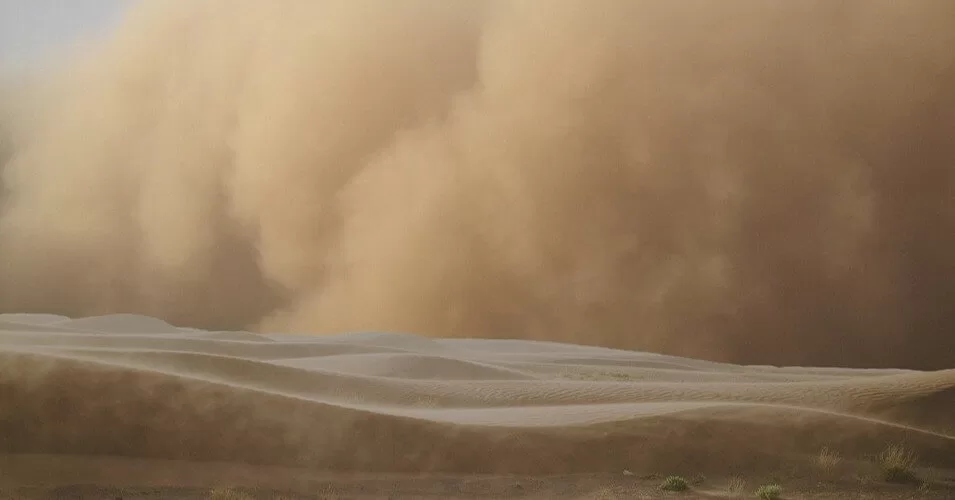
Clouds of dust from the Sahara Desert have spread across much of Europe and reached Ukraine. Strong winds lifted the dust and carried it thousands of kilometers northward.
According to NASA, winter winds lifted large amounts of dust from the Sahara Desert and transported them north toward the Mediterranean. In early March, dust clouds spread across large parts of Europe.
The GEOS (Goddard Earth Observing System) atmospheric model, which integrates satellite data, showed dust plumes originating in northwestern Africa. Some of the dust moved west across the Atlantic Ocean, while other plumes traveled north toward the Mediterranean and Europe.
Over several days the dust spread across Western Europe, where people observed hazy skies from southern England to the Alps in Switzerland and Italy.
In some regions the dust mixed with moisture in the atmosphere. As a result, rainfall carried the particles to the ground, creating so-called “dirty” or “blood rain” that left a brownish residue on surfaces.
Such rain was observed in Spain, France and southern parts of the United Kingdom. Meteorological services reported that a low-pressure system named Storm Regina moved across the Iberian Peninsula and contributed to the phenomenon.
Over the Mediterranean, so-called “dusty cirrus” clouds formed, where dust particles served as nuclei for ice crystals in the upper atmosphere.
Scientists are studying these clouds to better understand their impact on weather, climate and even solar power generation.
A recent analysis showed that high concentrations of airborne dust can significantly reduce solar panel performance. For example, in a study conducted in Hungary, photovoltaic efficiency dropped to about 46% on high-dust days compared with 75% or more on low-dust days.
Researchers also note that Saharan dust events affecting Europe in winter may be becoming more frequent in recent years. Possible causes include drier conditions in northwestern Africa and weather patterns that more often drive winds northward from the Sahara.