
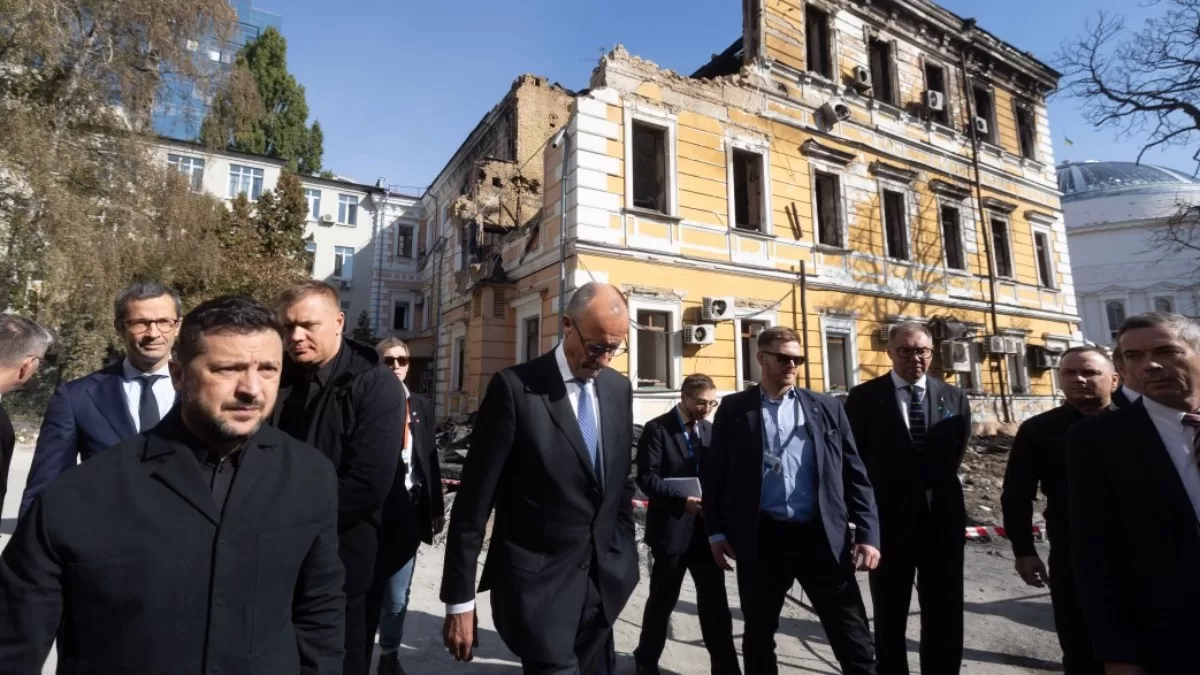
Ukraine and Germany reached agreements worth more than €8.5 billion during Chancellor Friedrich Merz’s visit to Kyiv and signed 15 agreements and documents. A separate comprehensive support package is worth more than €1.3 billion and includes military aid, joint weapons production and support for Ukraine’s energy sector ahead of winter.
This was announced by Ukrainian President Volodymyr Zelensky and German Chancellor Friedrich Merz during a joint press conference.
Zelensky described the meeting with Merz as “very productive” and said the new support package includes both weapons that Ukraine needs immediately and assistance for the energy sector.
“There is a new support package for Ukraine — a comprehensive package worth more than €1.3 billion. This is weaponry that will help now, as well as support for our energy sector ahead of winter — an important energy package,” the president said.
According to him, air defence was a separate topic of the talks, as the need for it is currently critical.
In total, the two sides signed 15 agreements and other documents. Most of them concern security cooperation, defence production, Ukrainian orders for German industry and joint projects in Ukraine.
“The total value of today’s agreements is more than €8.5 billion,” Zelensky said.
A separate agreement was also signed to expand Ukraine’s and Germany’s capabilities in countering drones.
Merz clarified that the new military aid package exceeds €1 billion.
According to the chancellor, Germany will finance the joint production of interceptor drones and supply Ukraine with long-range weapons, combat drones and satellite equipment.
“We are allocating funds for the joint production of drones to counter jet-powered drones. In recent weeks, major technological breakthroughs have been achieved in this area, and we are now moving quickly to launch them into serial production,” Merz said.
He also announced supplies of long-range weapons and satellite equipment that should help Ukraine more effectively target Russian launch systems.
Germany will provide another approximately €350 million to support Ukraine’s energy sector ahead of winter.
The funds are expected to be used for generators, transformer substations and repair kits to restore damaged infrastructure.
Merz said the package is intended to mitigate the consequences of Russian attacks on energy facilities and help Ukraine get through the winter period.
A separate part of the talks focused on countering new Russian jet-powered drones.
Zelensky said Ukraine expects the first results of a programme using small missiles against such targets in the second half of October.
“Next are small missiles, the small-missile programme. I will not name them now. There are several types. We will apparently see results this month, toward the end, in the second half of the month,” he said.
According to the president, the scale of further production will depend on the results of combat use.
“If there is a result, we will immediately be able to reach a proper production volume of the relevant product,” Zelensky added.
Ukraine is also working to increase the supply of 20 mm ammunition for F-16 fighter jets.
According to the president, the goal is to enable the use of 5,000-6,000 such rounds per day.
Ukraine has already been in contact with the Polish side on this issue. Zelensky also announced talks with Polish Prime Minister Donald Tusk and French President Emmanuel Macron.
Among Ukraine’s anti-drone systems, the best result so far, according to Zelensky, has been shown by the “Bars” interceptor drones, with a success rate of around 30%.
Special turrets are also being deployed. Twelve such systems have already been installed in Kyiv, with eight more planned. Fifty turrets have already been installed in the Kyiv region.
During the press conference, Zelensky also said Russia is expanding the list of civilian and infrastructure targets it attacks.
According to him, bridges, data centres, mobile communications facilities and other critical infrastructure are being targeted.
The president said the Ministry of Defence, together with local authorities, is working on alternative solutions in case of serious infrastructure damage, including in Kyiv.
“The Ministry of Defence is working together with everyone, with local authorities. And in any case, alternatives must be developed if there is a serious challenge to infrastructure,” Zelensky said.
He noted that this work is already underway in case Russian strikes are aimed at systematically destroying the capital’s infrastructure.
“I am honestly surprised by this brutal desire to escalate every day. In other words, he is counting on constant escalation. He very much wants this,” Zelensky said, referring to Vladimir Putin.
Merz also said Germany, together with France and the United Kingdom, plans to hold a meeting of the Coalition of the Willing in Berlin this winter.
One of the main issues at the meeting will be coordination of further military and other support for Ukraine.