
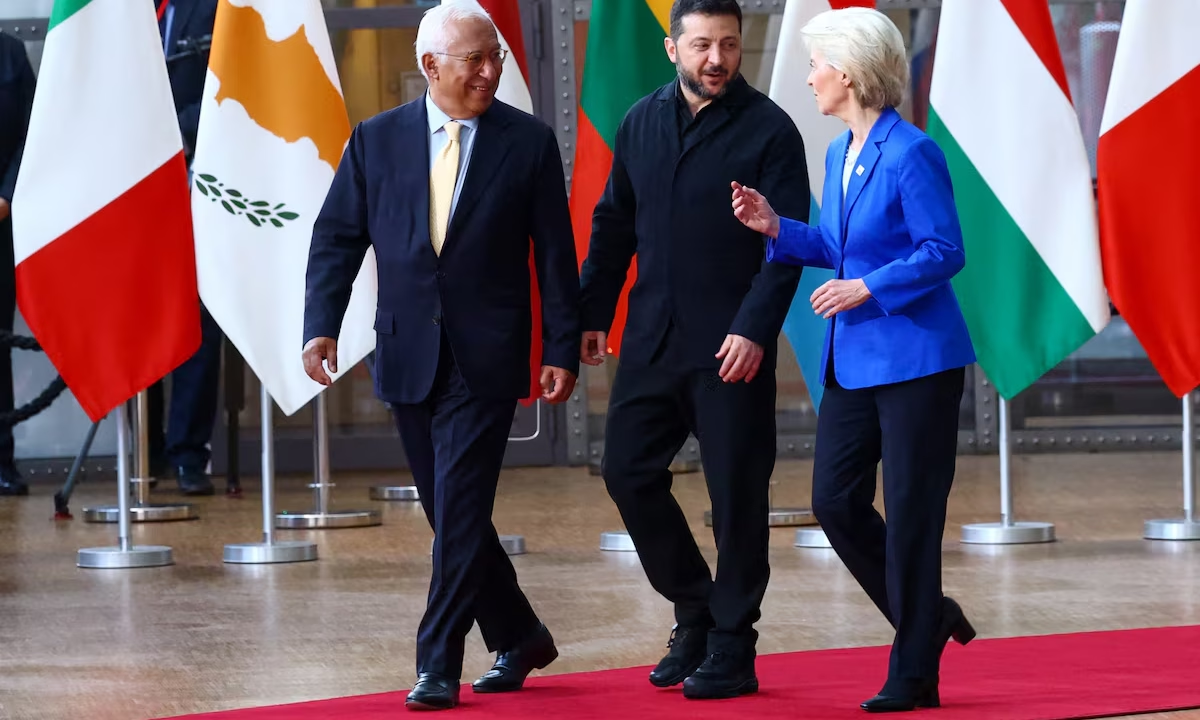
European Union leaders at a summit in Brussels are preparing to reaffirm their support for Ukraine at one of the most difficult moments in recent months, as Russian attacks intensify and relations between Kyiv and Washington deteriorate. Volodymyr Zelensky arrived in the European capital after Donald Trump called Ukrainian strikes on Russian oil refineries a “disgrace.”
This was reported by Reuters.
The summit is taking place amid concerns in Kyiv that the United States could scale back intelligence sharing and military support. At the same time, Russia continues to attack Ukrainian cities with missiles and drones.
Arriving at the meeting, Zelensky said Ukraine sees no signs that Moscow is ready to end the war and therefore must prepare for the winter.
“We want to end this war as quickly as possible. We do not see signals from the Russian side now that they are ready for this, to end this war, so we have to prepare for the winter,” the president said.
According to him, the issue goes beyond energy.
“The winter package is not only energy, it is also air defense and funding,” Zelensky said.
The president said he intended to discuss Ukraine’s needs through the end of 2026 and for 2027 with European partners.
Trump calls Ukrainian strikes on refineries a “disgrace”
Tensions between Kyiv and Washington intensified after Trump said Ukraine and Russia had supposedly agreed not to attack each other’s energy facilities.
According to Reuters, the announcement came as a surprise to Kyiv.
Ukraine paused strikes on Russian oil infrastructure for several days, but Zelensky later said Kyiv was abandoning the pause because Russia continued to attack Ukrainian energy facilities.
Ukrainian forces then struck another Russian oil refinery.
Commenting on the attack, Trump told Newsmax that strikes on Russian refineries were driving up global oil prices.
“All he’s doing is making the world oil price higher. Well, I think that’s a disgrace,” the U.S. president said.
Reuters notes that Trump has linked rising energy prices specifically to Ukrainian attacks on Russian facilities. At the same time, the sharp rise in energy costs has also come amid the war with Iran, which became one of the key issues at the current European summit.
European leaders push back against Trump’s rhetoric
Dutch Prime Minister Rob Jetten directly criticized the U.S. president’s latest remarks.
“This is not the right language. It is also in the interest of Trump to defend Ukraine in this war,” he said.
According to Jetten, the meeting will largely focus on how to deal with the new and complicated diplomatic situation and how to help Ukraine get through the winter.
At the same time, he acknowledged that he was dissatisfied with the number of countries willing to make new financial commitments to Ukraine.
“I am unhappy with the number of countries that have been willing to pledge new financial support to Ukraine. But we will see several countries pledging more military support soon,” the Dutch prime minister said.
Ukraine needs tens of billions of dollars
Funding remains one of Kyiv’s main concerns.
Earlier this month, Zelensky told Reuters that Ukraine had agreed on a plan with its European partners that should help close a $27 billion gap in military spending this year.
The funds are expected, among other things, to allow Ukraine to order the drones needed to continue fighting at the beginning of 2027.
However, the financing problem extends beyond the current year.
Finance Minister Sergii Marchenko recently said Ukraine still faces an unfunded budget gap of $32.6 billion next year.
That figure does not include an estimated $40 billion in direct military supplies from allies.
That is why Europe’s willingness to continue providing long-term financing to Ukraine is becoming one of the key issues at the summit.
“Is Europe ready to keep paying?”
Belgian Prime Minister Bart De Wever put the issue bluntly.
He said Zelensky would probably remind European leaders that previous financial assistance would not be enough for a prolonged war.
“He will probably look everybody straight in the eye and say, thank you for the 90 billion, but that money is going to run out because a war is a very costly thing,” De Wever said.
After that, he said, European countries will face the central question of whether they are prepared to continue financing Ukrainian society and defense.
“So are you, as a European family, still willing, ready and able to put your money where your mouths are and support Ukraine and keep Ukrainian society and Ukrainian defence up and running?” the Belgian prime minister said.
U.S. may ease sanctions on the “shadow fleet”
Another source of disagreement between Washington and its European allies is the Trump administration’s energy policy toward Russia.
According to Reuters, the U.S. administration is considering easing sanctions on so-called shadow fleet vessels that have transported oil and petroleum products, including from Russia.
European leaders have also criticized the Trump administration’s deal to purchase Russian diesel fuel.
At the same time, the EU itself is grappling with rising energy prices, which exposed divisions among member states on the first day of the summit.
Putin plays down impact of Ukrainian strikes
Amid the dispute between Kyiv and Washington, Vladimir Putin said Ukrainian attacks on Russian refineries had supposedly caused no serious damage.
According to him, they had caused “nothing particularly significant.”
At the same time, on the eve of Zelensky’s appearance at the EU summit, Russia moved to place local assets of companies from France, Germany, Sweden and the Netherlands under temporary management.
Reuters said Moscow took the step in response to the European Union’s support for Ukraine.
Russia intensifies attacks on Ukrainian cities
The European summit is taking place amid a new wave of Russian strikes on Ukraine.
Reuters reported drone attacks on Kharkiv, where local authorities reported deaths and injuries.
In the Volyn region, Russian strikes left around 370,000 people without electricity.
Emergency power cuts were introduced in Kyiv during Russian attacks.
According to Zelensky, these developments only increase the urgency of strengthening Ukraine’s air defenses ahead of winter.
Europe faces a decision over future support
The Brussels summit comes at a time when Kyiv is simultaneously facing Russian military pressure, a major funding shortfall and uncertainty over future U.S. policy.
Trump’s comments about Ukrainian strikes on Russian refineries have become another sign of growing disagreements between Kyiv and Washington.
Against this backdrop, European countries must decide how far they are prepared to go in providing financial and military support to Ukraine in 2027.
For Zelensky, the main objectives at the summit remain securing additional air defense systems, a winter energy package and funding guarantees necessary to sustain Ukraine’s defense.
Earlier, “Glavnoe in Ukraine” reported that a New York Times opinion column described Donald Trump’s latest decisions as giving Vladimir Putin an opportunity to shift the war in Russia’s favor. The author pointed to Washington’s pressure over strikes on Russian refineries, problems with intelligence sharing and restrictions on Starshield, arguing that a reduction in Western support could become the main threat to Ukraine.