
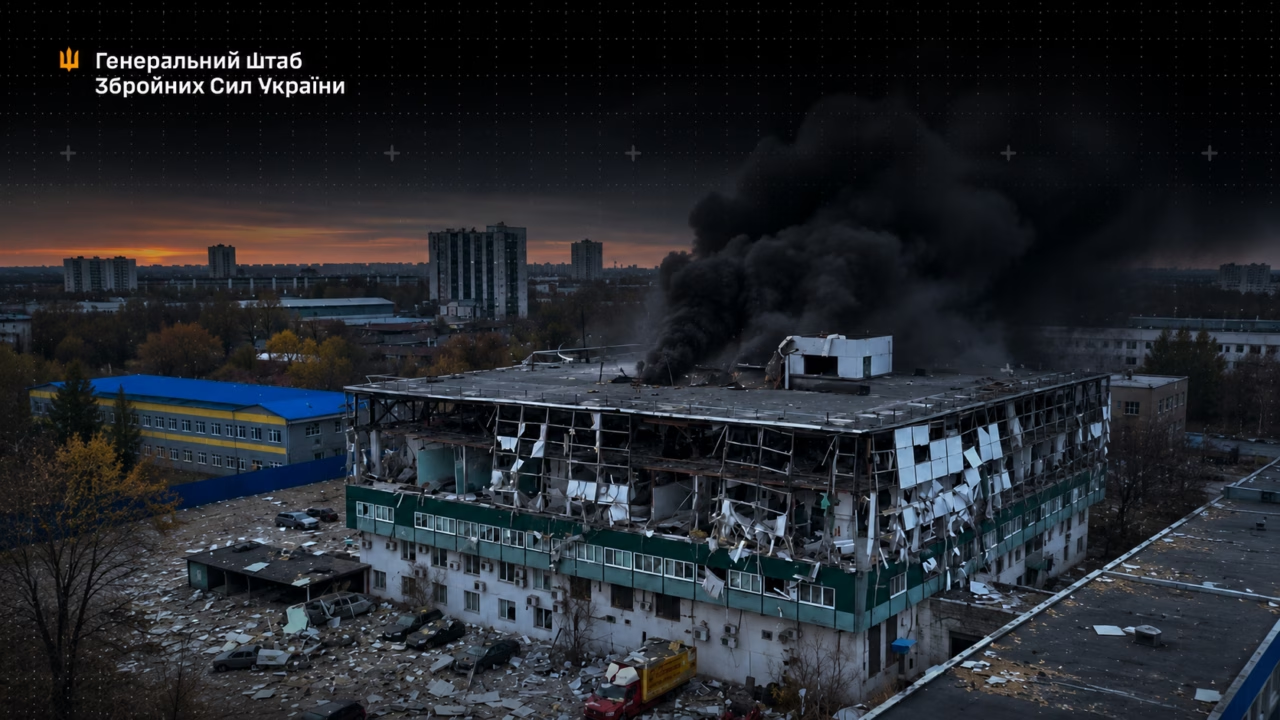
Throughout October 2026, Ukraine’s Defense Forces systematically struck Russian military-industrial facilities, airfields, attack drone storage sites and other targets linked to the production of missiles, aerial bombs and air defense systems. Separately, Ukrainian air defenses neutralized 4,859 of the 6,473 Russian Shahed-type attack drones launched during the month.
This was reported by the General Staff of the Armed Forces of Ukraine.
Among the ten key strikes in October, the General Staff named the Energia plant in Yelets, Lipetsk region. On October 25 and during the night of October 26, a workshop producing power elements for weapons systems was hit, causing a fire on the premises.
According to the General Staff, Energia is the only manufacturer of batteries for glide and correction modules used with aerial bombs. It also produces batteries for Iskander-M missile systems and sea-launched cruise missiles.
Plants producing missile components and solid rocket fuel
On the night of October 9, the Defense Forces struck infrastructure at the Redkino Experimental Plant in Russia’s Tver region. The facility produces Decilin-M fuel components for Kh-55 and Kh-101 cruise missiles.
On October 23, the Proton-Electrotex enterprise in Oryol was struck. According to the General Staff, the main microchip production workshop was destroyed, while the building and company servers were damaged.
The plant produces modules for S-71 Kover cruise missiles and switch-inverters for 9M723 Iskander-M ballistic missiles. It is also involved in producing Pantsir-S1 air defense systems.
On October 24 and 26, the Togliattikauchuk plant, the Yefremov Synthetic Rubber Plant and Voronezhsintezkauchuk were attacked. Synthetic rubber produced at these facilities is used in solid rocket fuel for tactical and ballistic missiles.
On October 9, infrastructure at the Intercontinental Ballistic Missile Disposal Center near Surovatikha in the Nizhny Novgorod region was also struck. The General Staff said the aim was to weaken Russia’s military-industrial capacity to produce explosives and rocket fuel.
Strikes on drone production and storage sites
On October 16, a production and storage building belonging to Roboavia in the Rostov region was hit.
According to the General Staff, the company develops and manufactures unmanned aerial vehicles for the Russian military.
On October 28-29, the Defense Forces struck attack-drone infrastructure near Navlya in the Bryansk region. A Geran drone storage facility, a drone port and a fuel and lubricants depot were hit.
Eight Su-34 aircraft at two airfields
Another focus of the October strikes was Russian combat aviation.
On the night of October 15, six Su-34 multirole fighter-bombers were hit at the Borisoglebsk airfield in the Voronezh region, according to the General Staff.
On October 29, two more Su-34 aircraft were destroyed at the Marinovka airfield in the Volgograd region in a strike carried out with Neptune coastal missile systems of the Ukrainian Navy.
The General Staff noted that the Su-34 is one of the main aircraft used by the Russian military to drop guided aerial bombs on Ukrainian frontline communities.
Strike on the Kamensky Combine
On the night of October 31, the Defense Forces carried out a combined strike on the Kamensky Combine in the Rostov region.
Attack drones and Neptune coastal missile systems were used in the operation.
A fire at a finished-products warehouse was confirmed, and four production workshops were damaged.
The enterprise produces solid rocket fuel for Uragan, Smerch and Tornado-S multiple-launch rocket system munitions, as well as for a number of other missile systems and air-launched weapons.
Air defenses neutralized more than 4,800 Shahed drones
Separately, the General Staff reported that Russia used 6,473 Shahed-131/136 and Shahed-238 UAVs against Ukraine during October. In Russian nomenclature, these are designated Geran-1/2/3/4/5.
Ukraine’s Defense Forces neutralized 4,859 of them.
According to the General Staff, the effectiveness of countering jet-powered Shahed-type attack drones in October was 66%, while conventional Shahed drones were neutralized at a rate of 89%.
Fighter and army aviation, anti-aircraft missile units, mobile fire groups, unmanned systems operators and electronic warfare assets were used to intercept the drones.
The General Staff noted that Russia continues to complicate its air attacks by changing flight routes and altitudes, combining attack drones with decoys and missile strikes.
Countering ballistic missiles remains a separate challenge, as Russia actively used them in October to strike civilian infrastructure in Ukraine.