
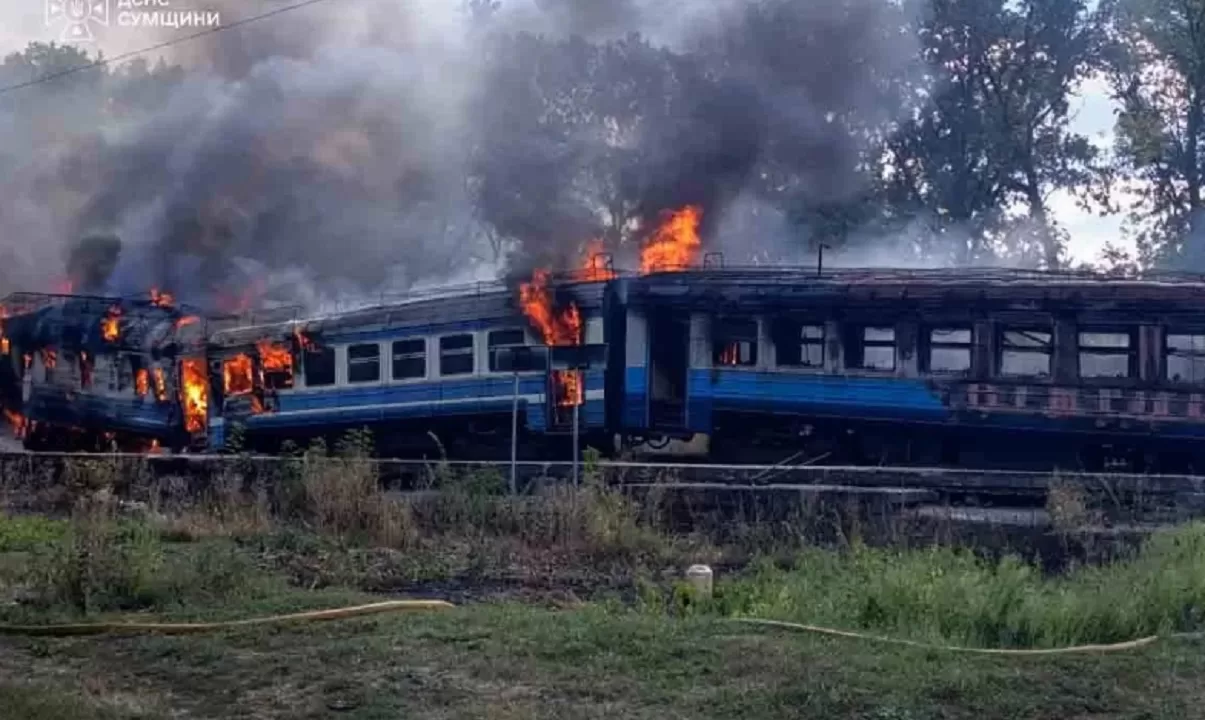
Russia is increasingly attacking Ukrainian passenger trains with jet-powered drones, threatening a railway network that is crucial to Ukraine’s economy, military logistics and movement of people. Since the start of the full-scale invasion in 2022, Russian strikes have damaged or destroyed more than 500 locomotives, with more than 60% of them hit in the past eight months.
This was reported by Politico.
According to the publication, Ukrainian Railways is now losing between 37 and 40 locomotives a month.
Russia’s Defense Ministry has acknowledged strikes on trains, saying they are part of a strategy to destroy Ukrainian logistics used to transport foreign weapons.
Oleksandr Pertsovskyi, chairman of the management board of Ukrainian Railways, believes Russia’s goals are much broader.
“Russians aim to isolate our frontline communities, sow panic and fear among the already exhausted locals, paralyze the economy,” he said.
Russia has begun attacking moving trains
According to Pertsovskyi, Russia began “hunting” passenger trains last autumn after obtaining antennas for mesh networks.
The technology allows drones to relay signals to one another or connect to ground-based transmitters in Belarus or occupied Ukrainian territory. This enables operators to control drones in real time despite electronic warfare measures and attack moving targets, including trains.
Pertsovskyi recalled a strike on a train near Lozova in the Kharkiv region last autumn that killed six people.
“Since then, we launched evacuation protocols. We’re saving most of the people, but Russians keep destroying our locomotives,” he said.
According to Politico, Russia primarily uses jet-powered drones against trains. Ukraine has not yet been able to fully counter this threat.
Ukraine’s Defense Ministry is working on a solution with counter-drone manufacturers. At the same time, Ukrainian Railways is developing an integrated transport model that would allow passengers to be moved by bus if train services are halted or trains are hit.
Attacks are spreading to western Ukraine
Most strikes take place within 200 kilometers of the frontline or the Russian border and mainly affect Ukraine’s eastern and southern regions.
However, according to Pertsovskyi, Russia has recently expanded the geographical reach of its attacks.
“Now Russians are using antennas and repeaters in Belarus to strike Ukraine’s western regions too,” he said.
Last weekend near the Polish border, a Russian drone struck a train shortly after another train carrying European security advisers and former political leaders, including former British Prime Minister Boris Johnson, had departed from the same station.
By the time of the attack, the diplomats had already crossed into Poland. Ukrainian Railways said it was highly likely that the drone’s intended target was the diplomatic train, which had departed earlier than scheduled.
“The latest strikes near the Polish border show that their additional goal is to increase risks for our foreign guests, partners, diplomats, politicians and reporters,” Pertsovskyi said.
According to him, Russia wants foreigners to be afraid to travel to Ukraine.
Passengers are evacuated directly from trains
Yulia Chykolba, Ukraine director at the Centre for Information Resilience, was traveling on another train from Kyiv to Chełm, Poland, that day.
According to her, the train was delayed by seven hours and passengers were evacuated twice because of a drone near the border.
“We were evacuated in a very organized way. Staff ordered passengers to leave the carriages and disperse as far away from the train as possible. And then we saw the drone approaching. The same one that later struck a train closer to the border. It was still scary,” she said.
Because of the delay, Chykolba missed her flight and reached her final destination in the Netherlands about 12 hours later than planned.
Ukraine is running short of locomotives
Because of the scale of Russian attacks, Ukraine needs funding for repairs as well as compatible replacement locomotives and spare parts. One new locomotive costs about €5 million.
“Locomotive repair is a key priority: spare parts, materials, and the personnel to carry out repairs around the clock,” Pertsovskyi said.
According to him, the European Bank for Reconstruction and Development and the World Bank are helping Ukraine, but the pace of destruction is so fast that available financial resources are insufficient.
The problem is not only about funding. Ukrainian Railways uses a 1,520-millimeter track gauge, while the standard across most of Europe is 1,435 millimeters. This significantly limits the amount of rolling stock that partners can quickly transfer to Ukraine.
Similar equipment is used only by the Baltic states and Finland. Lithuania has already pledged to provide locomotives to Ukraine as part of its winter support package.
Ukraine is also negotiating with other partners on additional assistance for the railway.
Pertsovskyi stressed that Ukrainian Railways is modeling various operational scenarios, but a complete shutdown is not being considered.
“Just as our country does not contemplate giving up the fight, the railway, naturally, does not contemplate halting its operations,” he said.