On October 3-5, Rating Group conducted a nationwide survey in Ukraine on socio-political attitudes, expectations for the winter, negotiations and electoral preferences. Most respondents support seeking a compromise to end hostilities, while Volodymyr Zelensky and Valerii Zaluzhnyi would receive the most votes in a hypothetical first round of a presidential election.
This is according to a Rating Group study.
Attitudes toward negotiations and territorial concessions
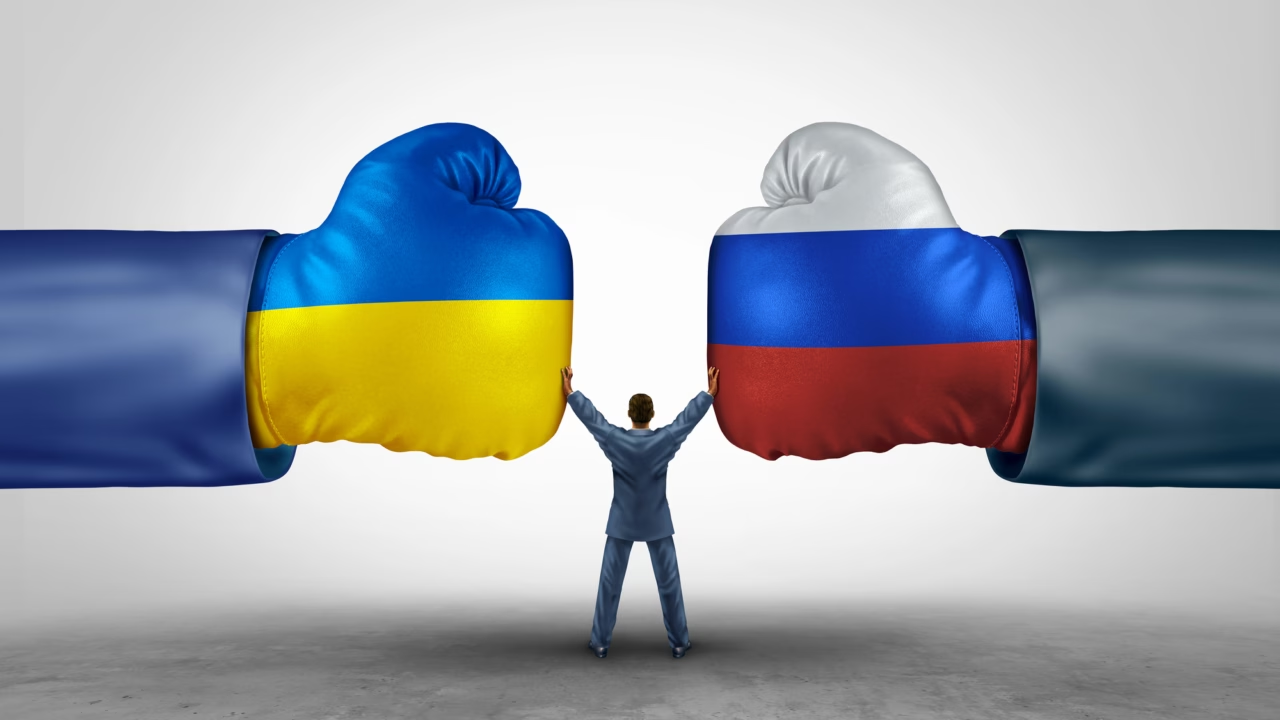
According to the survey, 57% of respondents support ending hostilities and seeking a compromise through negotiations. Another 13% favor continuing the fighting until Ukraine returns to the lines of control as of February 23, 2022, while 21% support fighting until the Donbas and Crimea are returned.
At the same time, 62% of respondents believe that neither Ukraine nor Russia is currently winning the war. Some 26% say Ukraine has the advantage, while 6% say Russia does.
For 50% of respondents, peace is more important than any victory, while 41% said victory is more important than any peace. Another 9% were unable to answer.
Most Ukrainians also see negotiations as a realistic way to end the war: 57% support seeking a compromise with the involvement of other countries, while another 26% favor direct negotiations.
Territorial concessions as a possible step toward achieving lasting peace are considered acceptable by 56% of respondents, but only if Ukraine receives security guarantees from the United States and European partners, including funding for the Defense Forces and weapons supplies. Some 35% oppose territorial concessions, while 3% are ready to accept them without preconditions.
If territorial concessions become a condition for peace, 68% of respondents believe the final decision should be made by the Ukrainian people in a nationwide referendum. Another 17% say the president should make the decision, while 9% say it should be made by the Verkhovna Rada.
Zelensky and Zaluzhnyi have the strongest support in a hypothetical first round
Respondents were also asked whom they would vote for in the first round of a hypothetical presidential election.
Volodymyr Zelensky would receive 22.9% of the vote, while Valerii Zaluzhnyi would receive 20.2%.
Petro Poroshenko and Mykhailo Fedorov would each receive 7.6%, Kyrylo Budanov 6.7%, Andrii Biletskyi 5.4%, and Dmytro Razumkov 5.1%.
Serhii Prytula would receive 2.4%, Yulia Tymoshenko 1.9%, and Yurii Boiko 1.4%. Another 4.5% would vote for a different candidate, 5.2% would not participate in the election, and 9.2% were undecided.
Who Ukrainians trust the most
Valerii Zaluzhnyi has the highest level of trust among the politicians, officials and public figures included in the survey: 64% of respondents trust him, while 25% do not.
Volodymyr Zelensky is trusted by 53% and distrusted by 40%. Kyrylo Budanov has the same trust rating of 53%, while 31% do not trust him.
Mykhailo Fedorov is trusted by 38% and distrusted by 25%, while 29% of respondents said they had not heard of him.
Petro Poroshenko is trusted by 24% of respondents and distrusted by 70%. Andrii Sybiha is trusted by 24% and distrusted by 18%, while 48% said they had not heard of him.
Majority expect a difficult winter
Ukrainians remain pessimistic about the economy and the energy sector. Some 71% of respondents expect the economic situation to worsen, while 63% expect deterioration in the energy sector.
At the same time, when asked specifically about energy supply, 47% said the situation this winter would be roughly the same as last year. Some 39% expect it to worsen, while 9% expect an improvement.
Expectations regarding the frontline are somewhat more optimistic: 33% believe the situation will improve during the winter, 30% do not expect significant changes, and 22% expect it to deteriorate.
As for the overall situation in Ukraine, 55% expect it to worsen, 25% believe it will remain roughly the same, and 12% hope for improvement.
The survey was conducted on October 3-5 using CATI telephone interviews among 1,000 Ukrainian citizens aged 18 and older. It covered all regions except temporarily occupied territories and areas where Ukrainian mobile communications were unavailable at the time of the survey. The maximum sampling error is 3.1% at a confidence level of 0.95.