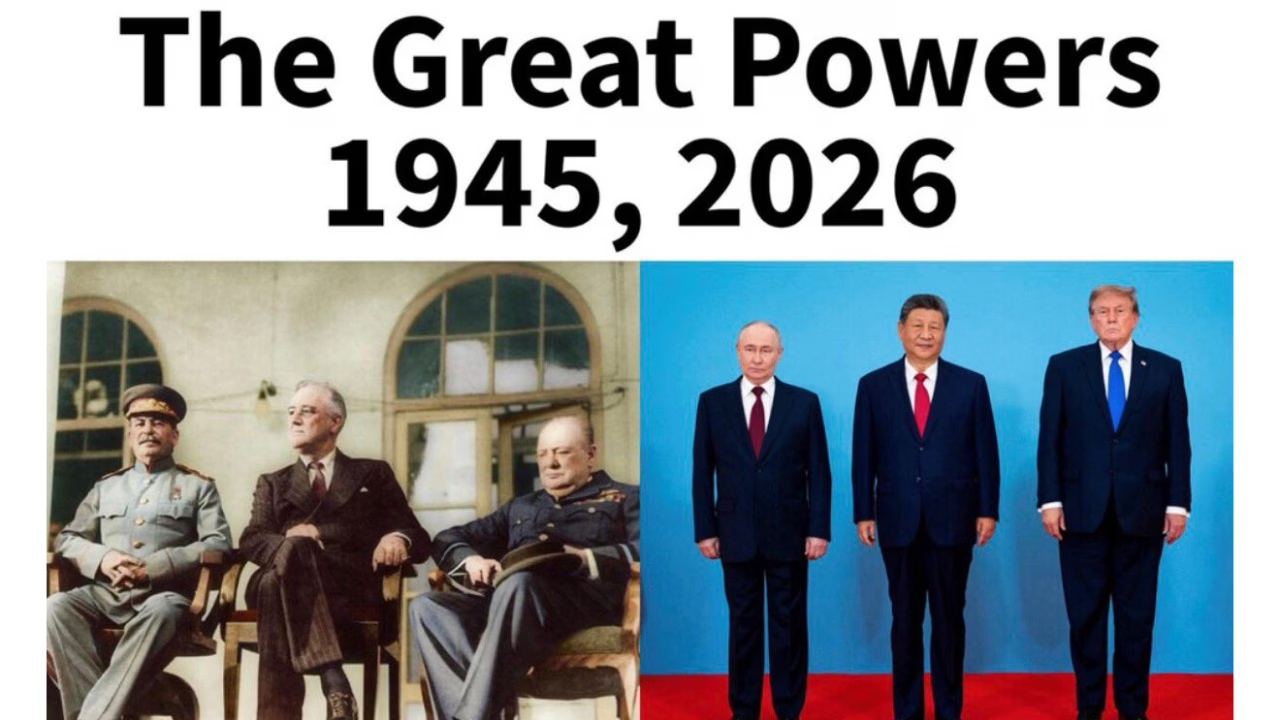
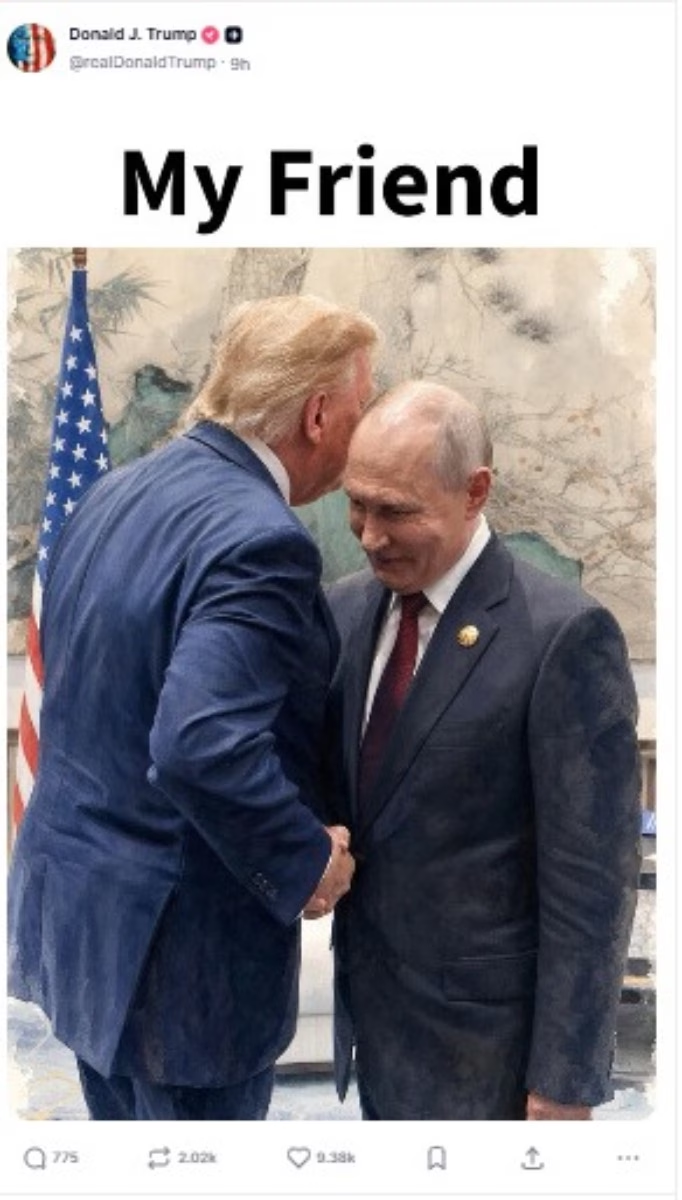
US President Donald Trump posted a series of photographs on Truth Social following his meeting with Vladimir Putin and Xi Jinping in China, including an image of himself shaking hands with the Russian president, captioned “My friend.” Another post references the 1943 Tehran Conference, where the leaders of the United States, Britain and the Soviet Union discussed the postwar order in Europe, including Poland’s future.
According to Polish media, two posts attracted particular attention: a photograph of Trump with Vladimir Putin bearing the caption “My friend,” and an image containing a historical reference to the 1943 Tehran Conference.
The latter carries particular symbolic significance for Poland because the meeting between Joseph Stalin, Franklin Roosevelt and Winston Churchill in Tehran included discussions of issues that would later determine the Polish state’s postwar fate.
Trump Calls Putin His Friend
The US president’s posts followed trilateral talks held on November 19 in Shenzhen, China, on the sidelines of the Asia-Pacific Economic Cooperation (APEC) summit.
The meeting brought together Donald Trump, Vladimir Putin and Chinese President Xi Jinping.
Following the talks, the leaders issued a declaration supporting peace, emphasizing the need to reduce nuclear risks and prevent the proliferation of nuclear weapons.
The meeting was also marked by several symbolic gestures.
According to Polish media, Putin was greeted at the airport by a Chinese official ranked fifth in the country’s senior leadership hierarchy. Trump, by contrast, was personally welcomed by Xi Jinping.
The interaction between the American and Russian presidents attracted particular attention.
According to the Polish publication, when Trump entered the room and saw Putin, he said: “Who is that? That’s my friend.”
Trump later posted a photograph of himself shaking hands with Putin on Truth Social, accompanied by the words “My friend.”
Historical Parallel With Tehran in 1943
Another of Trump’s posts contains a reference to a historic meeting of the leaders of the three major powers of the anti-Hitler coalition.
The image refers specifically to the Tehran Conference of 1943, not the Yalta Conference of 1945, as suggested in part of the Polish article.
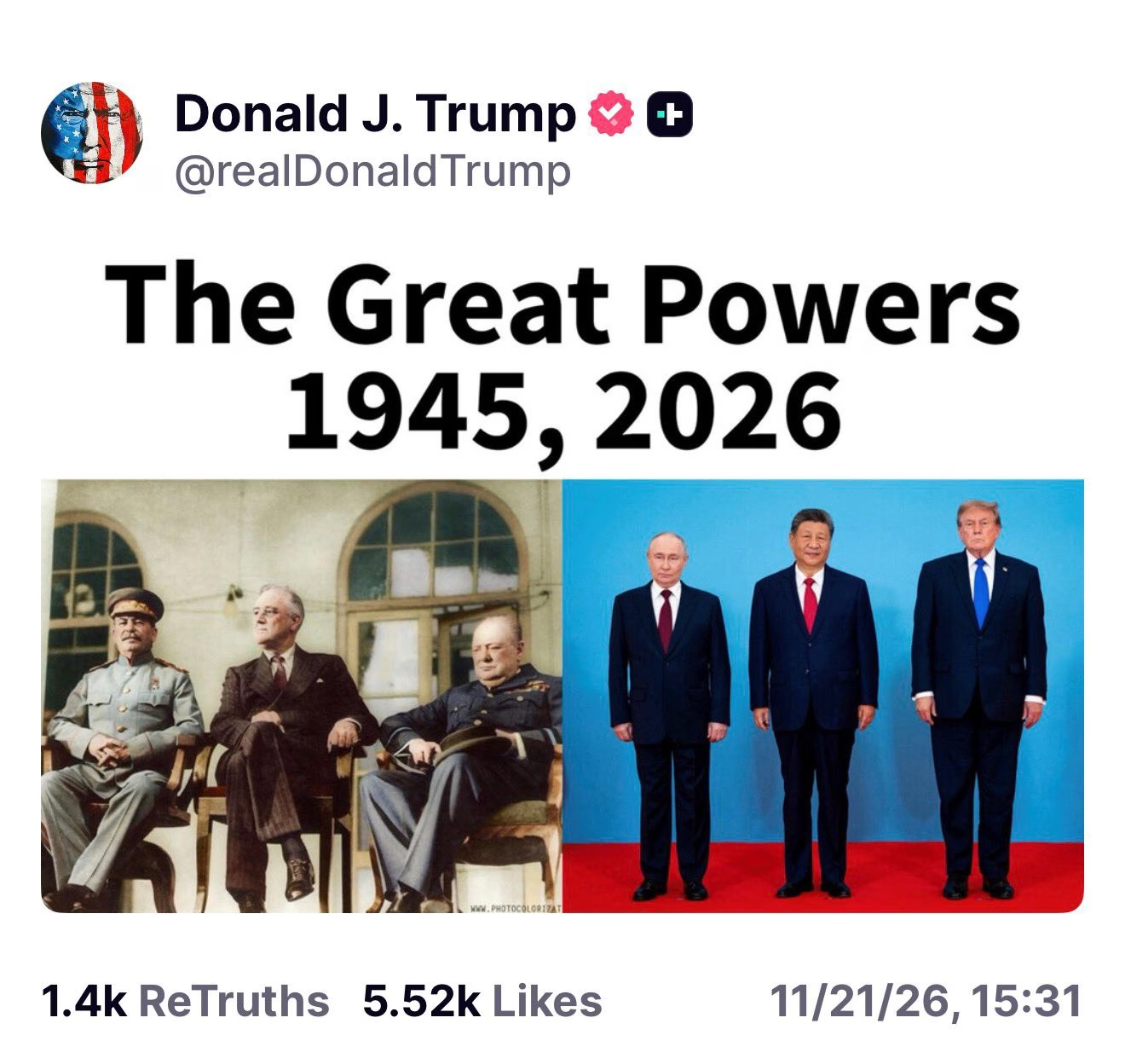
The Tehran Conference took place from November 28 to December 1, 1943, and was attended by US President Franklin Delano Roosevelt, British Prime Minister Winston Churchill and Soviet leader Joseph Stalin.
It was the first face-to-face meeting of the three leaders, who coordinated joint military operations against Nazi Germany.
The main topics included Allied military strategy, the opening of a second front in Western Europe and questions concerning the postwar order.
However, Poland’s future borders were also discussed in Tehran.
In particular, the leaders considered moving Poland’s eastern border westward, in line with the Soviet Union’s territorial claims. The idea was that Poland’s territorial losses in the east could be compensated with German territory in the west.
These discussions marked one of the preliminary stages in shaping the postwar European order.
Later, at the Yalta Conference in February 1945, the leaders of the Soviet Union, the United States and Britain returned to the Polish question, while subsequent agreements consolidated the new geopolitical realities.
As a result, Poland fell within the Soviet Union’s sphere of influence and remained politically, militarily and economically dependent on Moscow for decades.
Why the Photograph Has Particular Significance for Poland
In Polish historical memory, meetings between the leaders of major powers during World War II are associated not only with victory over Nazism but also with decisions about Poland’s future made without the country’s full participation.
That is why a reference to the Tehran Conference, in the context of talks between today’s leaders of the United States, Russia and China, evokes painful historical associations in Poland.
The possibility of major powers reaching agreements over spheres of influence and the borders of other countries is particularly sensitive.
However, the historical parallel itself does not prove that the talks in Shenzhen resulted in agreements on territorial changes or a new division of spheres of influence.
The Polish article provided also contains no explanation from Trump himself about the meaning he intended to convey through the post referencing the Tehran Conference.
Nevertheless, the combination of this historical imagery with the photograph of Trump shaking hands with Putin and the caption “My friend” attracted the attention of Polish media, which recalled the consequences of great-power negotiations for Central and Eastern Europe.