
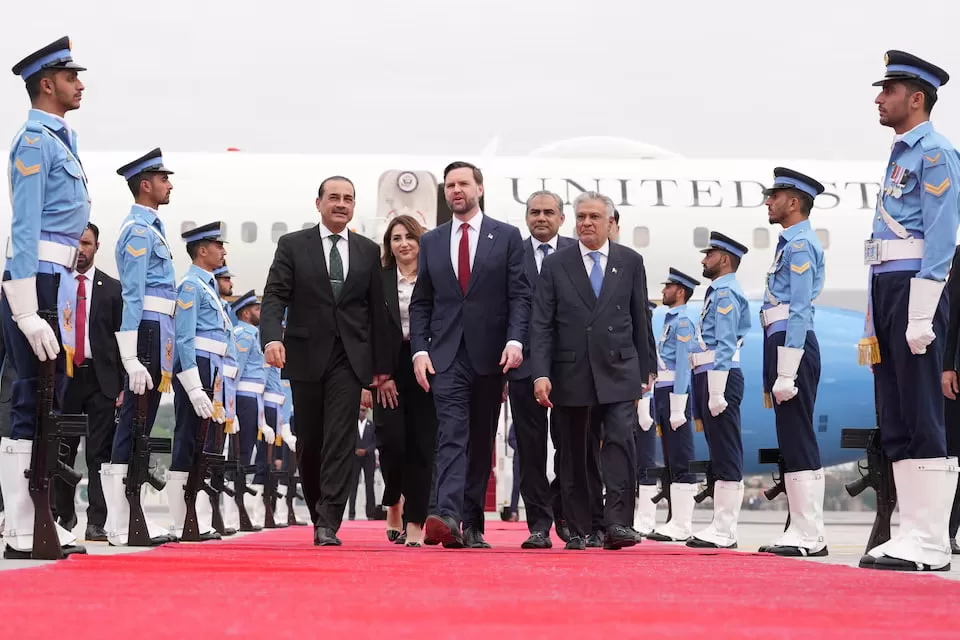
On April 11, delegations from the United States and Iran arrived in Islamabad for talks on ending the six-week war. At the same time, Tehran said the meetings would not begin without the fulfillment of its conditions.
This was reported by Reuters.
On Saturday, delegations from the U.S. and Iran arrived in the capital of Pakistan, Islamabad, for talks on ending the six-week war.
The American side is led by Vice President J.D. Vance. The delegation also includes President Donald Trump’s special envoy Steve Witkoff and Jared Kushner. They arrived on two U.S. Air Force aircraft at an airbase in Islamabad, where they were met by Pakistan’s army chief Asim Munir and Foreign Minister Ishaq Dar.
The Iranian delegation is led by Parliament Speaker Mohammad Bagher Ghalibaf and Foreign Minister Abbas Araghchi. They arrived in Pakistan the day before.
These talks could become the first official face-to-face contacts between the U.S. and Iran since 2015 and the highest level of engagement since the 1979 Islamic Revolution.
At the same time, Tehran questioned the start of the talks. Ghalibaf said the meetings would not take place until the U.S. fulfills prior commitments, including unfreezing Iranian assets and a ceasefire in Lebanon.
Iranian state media reported that the delegation is to meet with Pakistan’s Prime Minister Shehbaz Sharif to determine the format and timing of possible talks.
The U.S. and Israel, for their part, said the campaign in Lebanon is not part of the ceasefire with Iran, while Tehran insists it is.
Ghalibaf also said that Iran is ready to reach a deal if Washington offers a “real agreement” and ensures Iran’s rights.
Earlier, Donald Trump said that “the only reason the Iranians are alive today is the negotiations,” and added that Iran “has no cards except short-term blackmail of the world.”
Vice President Vance, before departing for Pakistan, said he expects a positive outcome, but warned that the U.S. negotiating team “will not be too accommodating.”
According to the Iranian agency Tasnim, the delegation from Tehran includes about 70 people, including technical specialists. Around 100 members of the U.S. advance team are also in the Pakistani capital.