
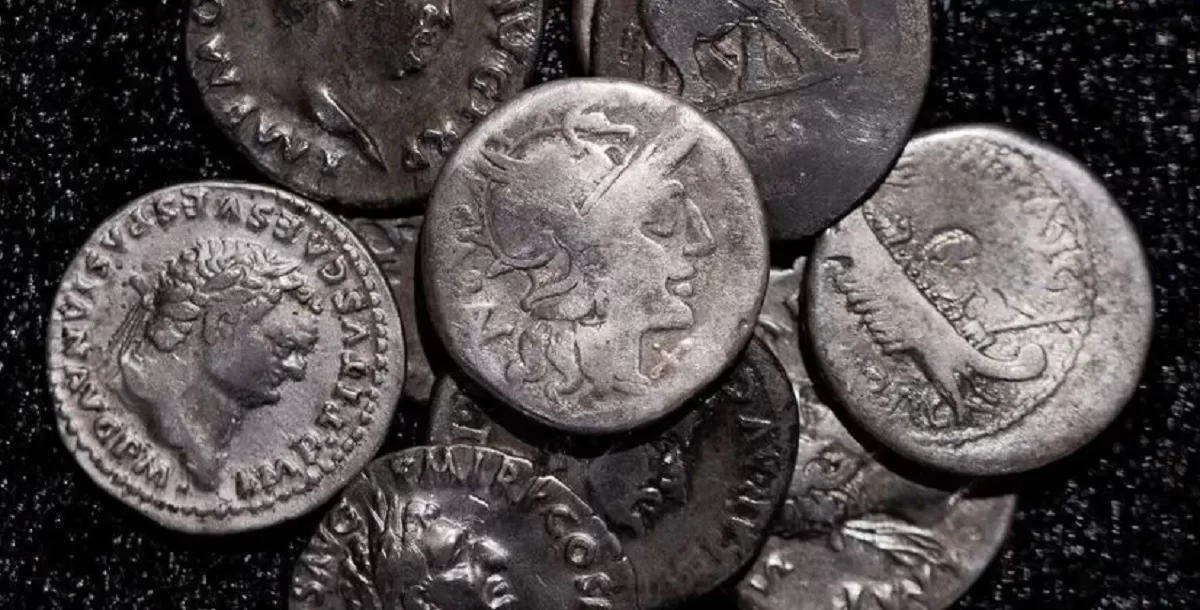
In Germany, the country’s largest hoard of Roman coins from the time of Emperor Hadrian was discovered in an ordinary agricultural field near Cologne. Archaeologists recovered 934 silver denarii weighing more than 3 kg in total, which were likely deliberately buried in the 2nd century AD.
This was reported by Der Tagesspiegel.
A man using a metal detector discovered the Roman hoard in a field near the town of Wesseling, south of Cologne. Oliver Riedl, a family man, found one silver coin after another and, after recovering 15 coins, realized that a much larger find could be hidden underground.
Instead of continuing to dig on his own, he contacted the LVR Office for the Preservation of Archaeological Monuments in the Rhineland. Archaeologists then carried out professional excavations and recovered 934 Roman silver denarii from the ground.
According to the LVR, this is the largest hoard of coins from the reign of Roman Emperor Hadrian ever found in Germany. Worldwide, it is the fifth-largest hoard from this period.
Experts believe the coins were buried in the second quarter of the 2nd century AD. The most recent coins date back to the reign of Emperor Hadrian, who ruled the Roman Empire from AD 117 to 138.
However, some of the coins are much older. The oldest was minted as early as 148 BC, when Rome was still a republic. By the time the hoard was buried, the coin was already more than 270 years old, yet it was still valid currency.
How much was the Roman treasure worth?
Archaeologists believe the owner of the coins may have lived on one of the Roman estates in the area. In ancient times, the territory belonged to the sphere of influence of Colonia Claudia Ara Agrippinensium — modern-day Cologne.
Experts say that in the 2nd century there was no banking system as we know it today, so people often buried their savings in the ground. It is impossible to establish why the owner never returned for the treasure. One possibility is that the person died without telling anyone about the hiding place.
LVR researcher Rahel Otte noted that a Roman legionary at the time earned about 300 denarii a year. Around half of that amount was deducted for food and equipment.
This means that a legionary would have had to save all of his disposable income for about six years to accumulate a sum comparable to the Wesseling hoard.
The material value of the silver today is just over €6,000, but the scientific value of the find is much greater because it provides new information about life in the Roman Empire.
The hoard was transferred to a museum
Archaeologists recovered the find together with a block of soil and transported it to the restoration workshop of the LVR State Museum in Bonn. This allowed specialists to examine not only the coins themselves but also the remains of the objects in which they had been stored.
Researchers found fragments of a ceramic pot and traces of straw. The coins were likely buried in a vessel lined with straw.
The discovered hoard became the property of the German state of North Rhine-Westphalia. Oliver Riedl, who had an official permit to search with a metal detector, will receive a reward from the state ministry.