Pope Leo XIV said that achieving peace in Europe requires patient dialogue, courage in negotiations and a willingness to seek compromises, while not abandoning international law. His remarks came against the backdrop of Russia’s war against Ukraine, although the pontiff did not directly mention Ukraine in this part of his speech.
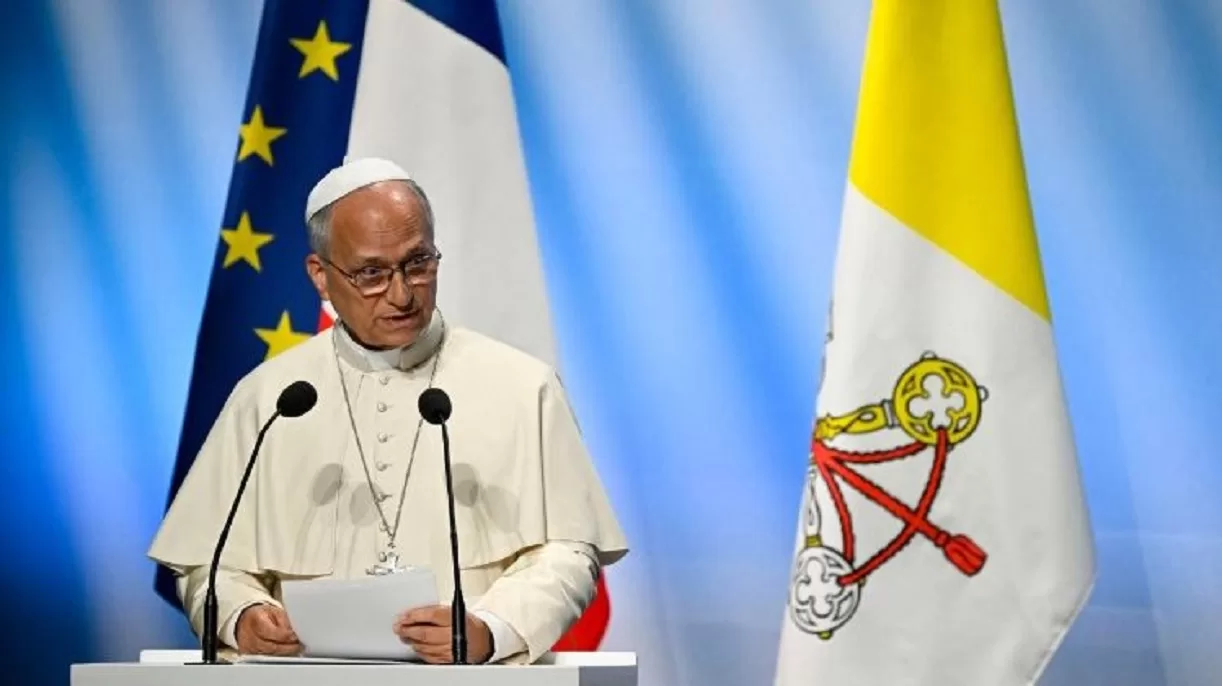
This was stated in the Pope’s address during the meeting “Toward the Roots of Europe for Peace and Unity” in the French city of Metz, published by Vatican News.
The meeting took place on September 28 at the Robert Schuman Congress Center and brought together representatives of politics, religion, culture and civil society, including heads of state and government.
“Patient dialogue is necessary”
One of the central themes of Leo XIV’s speech was peace in Europe. The Pope recalled that after decades of relative stability, war has once again returned to the continent and is claiming lives every day.
In his view, the experience of Robert Schuman, one of the founding fathers of modern Europe, remains relevant today.
“It is necessary to engage in patient dialogue, show courage in negotiations and be ready to give up some positions for the higher good of peace,” Leo XIV said.
At the same time, he stressed that the pursuit of peace should not turn into “naive irenicism” — the belief that conflict can be overcome through good intentions alone without taking real threats into account.
The Pope quoted Schuman, who emphasized that peace cannot be preserved without “creative efforts proportionate to the dangers that threaten it.”
Pope warns against the “illusion of rearmament”
The pontiff also drew attention to Europe’s military buildup. According to him, increasing military power alone cannot be the answer to the problem of war.
Leo XIV urged European states to consider whether their actions are truly aimed at establishing peace or merely at preparing for future conflicts.
“Today we should ask ourselves whether we are truly making ‘creative efforts’ to promote universal peace, or whether we are simply trying to ‘stop the bleeding of war’ and better prepare for the wars that we assume are yet to come,” the Pope said.
At the same time, the pontiff did not call for abandoning defense or security. His point was that military measures should be accompanied by political and diplomatic efforts aimed at establishing a lasting peace.
International law as the foundation of peace
Another key element of the speech was the need to restore respect for international law.
Leo XIV emphasized that after World War II, the European order was largely built on the principle of equality among states and the fulfillment of commitments.
Unlike the domestic laws of an individual country, international law cannot rely on the power of one state. That is why, according to the Pope, the principle pacta sunt servanda — “agreements must be kept” — is of particular importance.
“International law and multilateralism underline the effective equality of states in their mutual relations and are the best antidote to the desire for domination that lies at the root of every conflict,” Leo XIV said.
The Pope also warned that relations between states are becoming increasingly harsh, while the value of “one’s word” is being eroded.
According to him, Europe can counter this trend through respect for others and by returning to the principles on which the postwar European order was built.
Robert Schuman’s lesson for modern Europe
Leo XIV devoted a significant part of his speech to Robert Schuman, one of the architects of European integration.
The Pope recalled that Schuman lived in a region where borders changed repeatedly and European peoples fought one another for generations. In the pontiff’s view, this experience shaped his conviction in the importance of international law, cooperation and the rejection of revenge.
After World War II, Schuman became one of the politicians who sought to build a system in which former enemies would become economically and politically interdependent enough to make another major war far less likely.
For Leo XIV, this approach remains relevant today: peace does not emerge all at once, but must be built through concrete steps and mutual responsibility.
“Europe will not be built all at once,” the Pope recalled as one of Schuman’s key ideas.
Do not lose faith in the possibility of agreement
The Pope also urged Europeans not to expect immediate results from diplomacy.
According to him, European history demonstrates the value of gradual steps, patience and the ability to create mechanisms of cooperation even after large-scale wars.
“We should never lose faith in our ability to make progress, even if the steps taken are sometimes small and almost imperceptible,” Leo XIV said.
In this context, his call for negotiations concerns not only the moment of ending hostilities, but also the creation of a system of relations between states that could make another war less likely.
Christian roots and Europe’s future
Alongside the themes of war and peace, the pontiff devoted significant attention to Europe’s historical and cultural foundations.
Leo XIV said that European civilization cannot be fully understood without its Christian heritage.
He mentioned Saint Benedict and the role of monasteries in the development of education, medicine, science, law, architecture and social assistance.
At the same time, the Pope stressed that this does not mean establishing a confessional criterion for modern Europe. In his view, Christian heritage should help people understand the importance of human dignity, responsibility and openness to others.
Europe will have to learn to live together
Leo XIV also identified migration and the arrival in Europe of people fleeing wars, persecution and poverty as another challenge.
The pontiff believes this represents a historic encounter between different peoples and cultures that will require not only material assistance but also the integration of newcomers into society.
According to him, Europe must both preserve its own roots and remain open to dialogue.
Such an approach, the Pope believes, could become another foundation for reconciliation and lasting peace.
Appeal to young people: “Do not submit to the logic of violence”
Concluding his speech, Leo XIV addressed young Europeans.
He urged them not to see war, violence and confrontation as an inevitable condition of the world.
“Have the courage to responsibly carry out the mission of building peace in your hearts, in your relationships, in your families, in schools and universities, in the life of your cities, your countries and all of Europe. Do not submit to the logic of violence and oppression,” the Pope said.
Leo XIV also called on young people not to fear the future, to build families, participate in community life and politics, and defend human dignity.
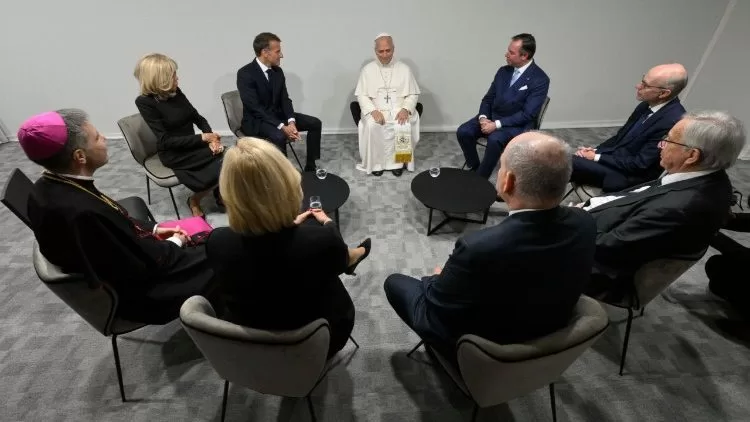
After the event, the Pope held a brief meeting with the heads of state and government who were present in Metz.